Blood and Dust by Jason Nahrung – review

Blood and Dust cover

About bloody time, Jason Nahrung. I’ve been waiting for something like Blood and Dust ever since I heard one of Nahrung’s short stories (Smoking, Waiting for the Dawn) on the Terra Incognita Speculative Fiction podcast a couple of years ago. Yes, yes – I know he released a sensitive almost literary novella recently filled with beautiful gothic themes and broody settings earlier in the year. I liked Salvage and thought it was a great read. But this is the novel I’ve been waiting for. Vampires in the Australian outback. Love it.

Kevin Matheson is a young mechanic in a small rural town somewhere out the back of the Australian state of Queensland. He dreams of marrying his high school sweetheart, taking over his father’s garage/service station and helping keep his rural community alive. Then a cop arrives dragging a prisoner with a stake through his heart, a dying partner and a truckload of vampire bikies behind him and Kevin’s life isn’t the same again.

Blood and Dust has been released as an eBook only from the relatively new Xoum. I’m always interested in what level of quality control a new publisher brings, and it seemed good with only a single typo jumping out at me. Xoum also published Perfections by Kirstyn McDermott recently, which I’ve reviewed here.

The world building in this novel is extensive, but inserted into the story in a seamless way. By the end of the novel I had a good sense of the much larger world outside the rural setting of the novel, but I never felt like there was a lot of info dumping. This is difficult to pull off, but Nahrung makes it seem effortless.

Be warned. There is violence. And sex. And sexy violence. And violent sex. On the whole, Nahrung does not hold back from exploring what the reality would be for creatures that needed blood to survive and for those that provide it. It may not be for everyone, but the everyday life of a Blood and Dust vampire provides a visceral backdrop to the storyline.

The pace is thriller-like, with escalating conflict all the way through. I tore through the book in a couple of sittings, ignoring my family and duties around the house. Thank <insert deity of choice here> I’m on holiday from work.

While the story is probably more plot driven than character driven, there is still significant character development through the novel. Not all the character arcs felt entirely complete, I suspect there may be plans for more writing in the world that Nahrung has created.

Some of the characters are Australian Aborigines, and there are themes of connection to land and dispossession that come through strongly in the novel. These will resonate strongly with an Australian audience, especially the references to the stolen generation of Aboriginal children forcibly removed from their parents and sent to live in white homes. There was a small reference to the fact that Aboriginal vampires had evolved differently from European vampires – I hope this is something covered in more detail in future work, it was a fascinating idea. I’m not Aboriginal myself and so can’t really comment on whether the Aborigines in the story were portrayed realistically, but it seemed believable to me.

As an Australian, I love reading speculative fiction that has an Australian sensibility. In Blood and Dust I particularly like the rural/outback setting. It is not the first place you’d think to place vampires (they’d probably blend in better in Melbourne – they all seem to like wearing black and being trendily miserable there). But using an outback setting adds a freshness to the tropes, and creates a real juxtaposition between undead creatures of the night and the sun soaked desolation of an Australian landscape in drought.

Now while I loved the “Australianess” of the story I did wonder while reading whether that local flavour would put off non-Australian readers. For those readers, I draw your attention to the Australian-English translation guide at the back of the book. Also I’d be fascinated to hear from any non-Australian readers on how you found the book. Leave a comment below!

Nahrung’s take on the vampire is interesting, and certainly harkens back to the darker interpretations of the vampire ethos. I particularly liked the way a connection is drawn between the vampire and those that provide blood, providing a natural check to their population growth. And the vampire familiars are equally well drawn, the “red eyes” who provide the vampires with a steady source of blood and daylight protection and are rewarded with youth, strength and vitality.

The writing itself is evocative and visceral. There is sentiment in the story, but it is not over done. Nahrung is comfortable portraying the dark and the macabre and the confidence of his writing is a joy to behold. I’m perhaps betraying my literary preferences, but this story is firmly in the genre camp and a joy to read because of it.

My thirst for Queensland vampires momentarily slacked, I find the desire for more work in this world starting to build already. Come on Jason, get on with it.

I also reviewed this book on Goodreads. View all my reviews.


Creative Commons License
This work by Mark Webb is licensed under a Creative Commons Attribution-ShareAlike 3.0 Australia License.

Perfections by Kirstyn McDermott – review

Perfections cover

This review forms part of my contribution to the Australian Women Writers 2013 Reading Challenge. All my 2013 AWWC reviews can be found here.


Perfections is Kirstyn McDermott‘s second novel, following the excellent Madigan Mine in 2011 (which I reviewed here as part of the 2012 AWWC challenge). The two novels are not related in terms of plot, although they do share a certain sensibility (which I’ve heard described by the author on her Writer and the Critic podcast as “modern urban gothic”). I enjoyed Madigan Mine, so have been looking forward to this release.

Perfections has been released as an eBook only from the relatively new Xoum. The quality was good, with only one typo jumping out at me. Given Xoum are also publishing a work from another of my favourite Australian authors (Blood and Dust by Jason Nahrung), they will be a publisher I’ll be keeping a close eye on in the future.

The blurb for the novel is Two sisters. One wish. Unimaginable consequences. Not all fairytales are for children. It’s hard to tell much more about the plot without giving spoilers, but it is one of those storylines that unfolds well. There are twists, but the twists felt natural. Rather than changes coming completely out of left field, I found that McDermott balances the foreshadowing well to ensure that when something was revealed my first thought tended to be “oh yes, in hindsight that is obviously what must have been happening”. That’s a difficult thing to get right – maintaining surprise while having fairly outrageous things feel natural.

There are some themes of emotionally abusive relationships, with hints of physical violence within those relationships. These themes are handled in a sensitive and nuanced manner, but are still very confronting.

There is a strong focus on the relationship between the two sisters. The characters are very engaging, this is something I noticed different from Madigan Mine where the characters were unsympathetic and in some ways difficult to engage with – I thought one of the strengths of MM was the way McDermott managed to drag you through the story despite the unsympathetic protagonist. In Perfections, the main characters (the sisters) are very sympathetically drawn, even when they are being slightly annoying. You want things to work out for them. And McDermott does an excellent job of playing on that sympathy as a source of dread for the reader.

Not all the characters in the book are sympathetic of course, and I thought the interplay between the minor characters was handled very well. Both the major characters went through significant growth, in particular in the nature of their relationship with others. The minor characters felt well realised, contributing their specific part to the story while staying three dimensional.

While the supernatural elements of the novel come in fairly early, the horror is more subtle, with less “jump in your seat” moments and more “stays with you and creeps you out at unexpected times in the future” moments. Stepping back from specific sentences and paragraphs, I found the writing generally to a) be beautiful and b) leave you with a slightly off balance feeling. Even in the sections of the book that are describing relatively mundane life, there is something about the way things are described that adds to the sense that there is something wrong, that things aren’t quite right.

This leads into the pacing, which was very good. I flew through the book and never felt that the pace dragged. Reading on the Kindle it’s easy to lose track of how far you are through a novel, I was surprised when I noticed I was almost at the end after only a couple of sittings. I put this speedy read down to a combination of wanting to resolve the mystery of the plot and my attachment to the main characters.

I loved the ending. Now, I’m not sure how much I can really say beyond that without giving anything away. But the ending does a great job of both resolving plot and character development.

Another excellent book by McDermott. Highly recommended.

I also reviewed this book on Goodreads. View all my reviews.


Creative Commons License
This work by Mark Webb is licensed under a Creative Commons Attribution-ShareAlike 3.0 Australia License.


A Memory of Light by Robert Jordan and Brandan Sanderson – review

A Memory of Light cover

Like a lot of people I’ve been reading The Wheel of Time series for 20 years, so it was with a sense of great relief that I approached reading A Memory of Light, the last of 14 books. There must be at least between 2 and 3 million words in the series, and in my younger years I re-read quite a few of the earlier books, so I think it is fair to say that I’ve invested more reading effort into The Wheel of Time than any other fantasy series.

It is interesting looking at the books now – a lot of modern epic fantasy seems to have moved away from the clear “good vs evil” plots and characters, and show people in more shades of grey (I’m think of Joe Abercrombie, George RR Martin etc), so in some ways reading A Memory of Light (and the proceeding few books) is like stepping back in time to a younger, more idealistic version of myself.

I don’t really want to spoil anything, so I’ll restrict my comments on the plot to say that basically this is a 900 odd page description of the last battle between good and evil. There is a lot of heroic self sacrifice, huge battle scenes and general mayhem. If you haven’t read the proceeding 13 books, this is not the place to start. If you are thinking about reading the series, you better start at the very beginning. I’ll see you in about a year, then we can compare notes.

Interestingly in the first half of the book I actually found myself enjoying the thread associated with the Black Tower most of all, populated with relatively minor characters. I always wished the Black Tower storyline had been fleshed out a little more in the earlier books.

I suppose it was inevitable with so many story threads to wrap up, but the book switched between point of view characters at an extremely rapid rate. Some aspects of the plot resolution were expected, some surprising. Some threads seem to have been left by the wayside.

Sanderson has done a good job finishing off the series (even if he did turn one book into a very large trilogy). I hadn’t come across Sanderson before he took over the Jordan franchise, and I’ve enjoyed his other work (such as the Mistborn trilogy and more recently The Emperor’s Soul). While there is a detectable different in style between the first 11 books and the last 3, I don’t think the change was bad. In fact, I think it brought a freshness and energy to the end of the story which I quite enjoyed.

So to the main question: how do I feel about how the series wrapped up? I’m not sure. The finish was quite predictable in broad terms, but I was interested to see the specific endings for specific characters. It’s hard to say much more without spoiling, and the book is a bit too newly out for that. Once you’ve read the book, buy me a drink at a Con or something and we’ll hash it out.

I also reviewed this book on Goodreads. View all my reviews.


Creative Commons License
This work by Mark Webb is licensed under a Creative Commons Attribution-ShareAlike 3.0 Australia License.

Quiver by Jason Fischer – review

Quiver cover

Quiver by Jason Fischer (subtitled The Tamsyn Webb Chronicles) is a young adult zombie apocalypse story. Now I’ve said it in tweet and I’ll say it again – from my perspective it seems genetically unlikely that any Webb could be heroic. But it was an intriguing enough concept that I felt compelled to read. Also, I’ve read and enjoyed some of Fischer’s other works (mainly in short stories, although I did recently read and review his novella Anomaly in the Viral Novella series).

The world is almost overrun by zombies, and the hero of the story (Tamsyn Webb) is holed up with a village of survivors in the walled town of Gravesend in the south of England. Tamsyn is a crack shot with the bow (great for bringing down zombies silently) and at the age of 17 is already part of the guards that keep the town safe. The main thread of the story follows Tamsyn’s attempts to find somewhere to live that doesn’t have the constant threat of imminent zombie destruction hanging over it.

The book is broken into four parts, based on four novellas originally produced for the After the World magazine (Gravesend, Corpus Christi, Army Corpse and Better Red Than Undead). I hadn’t come across any of the novellas, so I was a bit confused when at the start of the second “chapter” (Corpus Christi) there was a little summary of everything that had happened in Gravesend. I thought “yes, I know all this – I just read it!”. It made a lot more sense when I worked out they were originally independent publications.

I would say the novel is targeted at young adult, but there is enough violence and “adult themes” to mean it is probably best read by late teenagers and above. Unless you’re looking to prepare your young teen for the gruesome reality that will be the zombie apocalypse. The writing is excellent (as I’ve come to expect from Fischer), and the story finds a good balance with showing the world spanning nature of the crisis (mainly through the wide variety of locations visited), while keeping the main narrative more intimate (through focusing on Tamsyn’s story). Fischer creates a very horrific environment, both in terms of the description of the zombies themselves, but also the reaction of the human race.

The character of Tamsyn is interestingly portrayed, very self involved to the point where I actively had to keep reminding myself that she was only in her late teens to prevent myself getting too annoyed. This led me to find Tamsyn on the edge of being unsympathetic, but that could be the standard reaction of the middle aged towards the young. Fischer treads a good line between showing a young woman buffeted by overwhelming circumstances and giving Tamsyn enough agency to keep the story engaging.

Fischer draws on the natural elements to contribute to the general mayhem, and the variety of locations used (from the cold of England in winter to the tropical delights of the Caribbean) means that this doesn’t feel repetitive. Indeed, it could be argued that the unthinking undead are another form of natural disaster.

The later two chapters (Army Corpse and Better Red Than Undead) are a bit more fast paced and with more references to military hardware. It did make me wonder whether Fischer was influenced by his work on the Viral Novella series to bring a bit of the techo-thriller genre into his zombie apocalypse. The tension certainly does get escalated as a result, and it is a very effective way of showing the increasingly military nature of the remnants of humanity when faced with a threat of this kind.

Overall a very enjoyable read.

I also reviewed this book on Goodreads. View all my reviews.


Creative Commons License
This work by Mark Webb is licensed under a Creative Commons Attribution-ShareAlike 3.0 Australia License.

Evaporating Genres – Essays on Fantastic Literature by Gary K. Wolfe – comment

9062609

OK, I should start by saying it feels a bit funny writing down my thoughts about a book that rigorously covers the reviewing process. I’m not an academic, a well known writer or critic. I feel a need to note that I am one of those untrained, unskilled people who just whack up their opinions on their website in a fundamental absence of any comprehensive appreciation of the speculative fiction field and its history.

Consider yourself warned!

I came across this collection of essays as a part of one of my favourite podcasts, The Writer and the Critic episode 26, where it formed part of their “non-fiction” edition. I haven’t listened to the podcast yet (I wanted to finish reading first), but I’m almost certain that Kirstyn and Ian will have more interesting things to say about the book (well Kirstyn anyway – zing!). I strongly recommend checking their podcast out if you haven’t already.

Evaporating Genres contains eleven essays written by Gary K. Wolfe, well known speculative fiction academic (and presenter on the Coode St Podcast with Jonathan Strahan). Two of the essays are co-written with Amelia Beamer. The book interrogates the speculative fiction field and while it is hard to pick a single overarching theme (the essays have been written at different times and from different perspectives), as the title suggests Wolfe does often come back to the idea that most speculative fiction genres are difficult to define, especially around the edges, and that this fragmentation is part of what keeps the genres inventive.

The book itself is divided into three main sections:

  1. Genres – focusing on various genres that make up speculative fiction and some of their defining characteristics (7 out of the 11 essays)
  2. Writers – focusing on the approach of various writers (and “types” of writers) in creating speculative fiction (3 out of the 11 essays)
  3. Critics and Criticism – the history of criticism in science fiction and the role of different types of criticism (with particular emphasis on the work of John Clute – well known reviewer and encyclopaedia-ist) (1 out of the 11 essays)

I don’t intend to give essay by essay comments for a few reasons – I’d probably grossly misrepresent the arguments in the essays, it would take too long and there is a lot of nuance that comes from reading the detail that I would be incapable of replicating in a review. I will say that if you’re reading on a Kindle, the essays themselves finish at about the 62% mark (believe me, this is useful information). I have to be honest and say that I didn’t read all the footnotes.

Generally speaking I found the essays to be informative, thoughtful and articulate (although the language is a little dense at times). I don’t often read more academic subject matter, so it took a little while to get into the swing of the language etc, but the book does reward the effort. I found if I didn’t worry too much about not having heard of a lot of the writers/publishers/editors referenced, the general points made were intellectually stimulating and did lead me to do a bit more investigation into some of the earlier examples of speculative fiction. At the very least it has given me some context for listening to Wolfe in the Coode St Podcast!

Twenty-First-Century Stories was probably my pick of the essays. It investigated the work of many modern authors whose work deliberately pulls apart genre conventions. I’ve heard terms like slipstream and interstitial used a lot in podcasts and at conventions, but this essay was the first time I’ve really had a chance to grapple with the implications of those terms (and others like them).

Evaporating Genres (the essay for which the collection is titled) was also intriguing, providing the broadest coverage of the central theme of the collection (that speculative fiction genres are, by their nature, definitionally unstable).

Pilgrims of the Fall gives a fascinating glimpse into the world of academia and general review. Understanding the history of how more formal study of speculative fiction grew over the 20th century was interesting, but also gave me a new perspective on the tendency of speculative fiction to see themselves as outside the literary establishment.

I don’t have a thorough grounding in the history of the speculative fiction field, and I found reading these essays to be very valuable in giving me context for my own writing. You get a flavour of this kind of thing listening to the Coode St Podcast, but the essays are more comprehensive and explore ideas more rigorously.

However after some thought I’ve decided that as a writer there is some danger in reading an academic treatment of the field you write in. Namely, the academic has spent some considerable time underpinning their research with a solid foundation of theory. This can make it seem like the authors referenced were doing significant research/theoretical work to to ensure their novels took their rightful place in the speculative fiction canon. Meaning is ascribed to the work of those authors, where the academic has the benefit of both hindsight and history. As a result, I know I found myself wondering why I bother writing – I certainly don’t have the theoretical background to ensure that my work interrogates genre definitions so deliberately. However I comforted myself with the thought that many of the authors referenced may not have realised that was what they were doing until someone told them about it later. So there may be hope for me yet.

There is a lot for speculative fiction writers to think about in the definition of genres, more than I had initially thought. How much of what we write is subconsciously informed by the “rules” of the genre we have chosen to write in? How many of those rules are useful and exist for a purpose, or have evolved through a kind of literary natural selection? Where should we be rethinking them? And if those rules have evolved for a reason, what may be the unintended consequences of our departure from the norm? This collection has led me to think about these kinds of issues, which I’m sure will improve my writing in the long term.

Anyway, they are just a few thoughts on what is a varied and fascinating collection. Highly recommended, especially for speculative fiction writers.

Right, now I can get on with listening the the WatC podcast. As you were.

I also reviewed this book on Goodreads. View all my reviews.


Creative Commons License
This work by Mark Webb is licensed under a Creative Commons Attribution-ShareAlike 3.0 Australia License.

Astonishing X-Men – review

Astonishing X-Men

When I was a kid I loved the idea of comic books. Super heroes were cool. Spiderman in particular. But the reality was I didn’t get enough pocket money to easily afford comic books, especially on an ongoing basis. It was also difficult to find a newsagent that reliably stocked particular series. So, besides a few Phantom comics that inevitably came with Christmas presents, I really didn’t get into comic books.

When I was old enough to get a part time job, it seemed that the comic book phase had passed me by. I remember spending a few weeks trying to work out which Spiderman comic was the actual Spiderman comic and eventually I just gave it all up as being too complicated. As a result I have a functioning knowledge of superhero lore, based mostly on various animated TV series, but scratch the surface and my lack of depth is instantly revealed.

So, inspired by a combination of childhood regret and reading some of Tansy Rayner Roberts excellent blog series on female super heroes Where the Wonder Woman Are, I decided to read the Astonishing X-Men run written by Joss Whedon.

Plot summary: A group of X-Men (Cyclops, Wolverine, Shadowcat, Beast, Emma Frost) has started up the school for mutant children again. The overarching plot involving alien conspiracy, someone back from the dead, prophecy and a lot of blowing things up.

It was a fun experience. The series contains a nice, bounded story arc. There are some bits where having a broader knowledge of what else has happened in the X-Men universe would probably enhance the reading experience, but generally speaking you could fill in the gaps with even my cursory knowledge.

Reading comics is a very different experience. It took me a few issues to get to the point where I could “seamlessly” read dialogue etc – at first I kept getting pulled out of the story to try and work out who was saying what. Once the act of reading became more intuitive, the combination of artwork and dialogue made for a very immersive environment.

With the relatively short length the story itself wasn’t very sophisticated and a lot of the emotional depth seemed to rely on the assumption that the reader had a long history of interacting with the characters. The story itself is quite epic in scope, aided by the artwork to give that extra oomph. I enjoyed it well enough, but I would say it was broad and shallow. The various story arcs come together well, with satisfying resolutions to most plot questions.

Whedon’s dialogue is great with some fantastic one liners and the some of the plot elements were quite reminiscent of his other work.

I also used it as an opportunity to try reading comics on the iPad. I then realised that because of the aforementioned lack of comic reading I didn’t actually have anything to compare it to. Still, the iPad does seem like an excellent way of consuming comics. Easy to access, just the right size and form factor.

Will I keep reading comics? I’m not sure – I don’t think it is my preferred form of story consumption. I might see if I can find a single title I can keep up with, I think that would more than satisfy any comic cravings. And I did really like Spiderman when I was a kid…


Creative Commons License
This work by Mark Webb is licensed under a Creative Commons Attribution-ShareAlike 3.0 Australia License.

Pyrotechnicon by Adam Browne – review

Pyrotechnicon cover
Pyrotechnicon cover

Pyrotechnicon by Adam Browne is about, as the subtitle indicates, the further adventures of Cyrano de Bergerac among the states and empires of the stars. I’ve got to admit that the sum total of my knowledge of the character of Cyrano de Bergerac comes from watching the 80’s romantic comedy Roxanne starring Steve Martin. Which is based on a play written in the late 1800s. Which bears almost no relationship to the life of the real de Bergerac in the mid 1600s. Who wrote proto-science fiction based on an interesting version of his life story, which apparently involved travelling to the moon and the sun. Of which this book is notionally an extension.

Confused? Bloody hell, I am.

So to go back to my source material: big nosed, highly capable man chasing his love Roxanne. And a vague memory of a whole lot of nose related jokes. Not a lot to go off I admit.

Fortunately this was enough to get me into the story, and I’m glad it did. This was a delightful novel to read and stands amongst my favourites for the year. The plot is absurd. The characters larger than life. The settings bizarre and fantastic in the extreme.

But all this is almost inconsequential to a readers enjoyment, because the writing is a joy to behold. It takes a chapter or so to get into the rhythm of the novel but once you’re there this book rewards a leisurely read, just soaking it all in. It reads as a series of set pieces loosely connected together. The language is full of pith and wit, with a faithfulness to 17th century science which is impressive. I enjoyed seeing a series of long out-dated ideas in science taken to their logical extreme by the narrative. It was also refreshing to read science fiction that makes no attempt to fit with modern ideas of science.

I’ve had a couple of goes at trying to describe some of the plot, but it always comes out sounding much weaker than it should. I’ll try again: de Bergerac’s love Roxanne is captured by the mysterious Master of Secrets and taken to his lair, which happens to be located on Venus. de Bergerac sets off in pursuit in an elephant shaped space craft powered by rocks from Venus. Hijinks ensue.

Told you I wouldn’t do it justice. I’m not going to describe any more, as half the enjoyment from the book comes from the anticipation of absurdities to come. And Browne does a great job of coming up with stuff you just wouldn’t have thought of, even when steeped in the surreal world he has created.

There are not many laugh out loud moments in the book, but it is nonetheless amusing all the way through. Some of the amusement is derived from weird and wacky situations, some from the bizarre science that just shouldn’t work, some from outrageous characters and some just from the sheer wit of the prose.

I read this novel on my Kindle, where Browne’s illustrations also come up beautifully. The only technical issue I had with the book was that the text was tiny on the Kindle, I had to ramp the font size up to almost maximum in order to read it. A minor quibble though for an otherwise excellent publication.

Highly recommended.

I also reviewed this book on Goodreads. View all my reviews.


Creative Commons License
This work by Mark Webb is licensed under a Creative Commons Attribution-ShareAlike 3.0 Australia License.
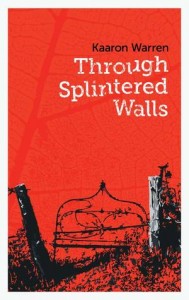
Through Splintered Walls by Kaaron Warren – review

13793120

This review forms part of my contribution to the Australian Women Writers 2012 Reading Challenge. All my 2012 AWWC reviews can be found here.


Through Splintered Walls by Kaaron Warren is one of the Twelve Planets series published by Twelfth Planet Press (12 boutique collections of stories by Australian women writers). It is made up of four shorter stories, including:

  • Mountain
  • Creek
  • Road
  • Sky

Through Splintered Walls is a disturbing collection, which uses an Australian backdrop and seemingly mundane settings and twists them quite savagely in parts. The supernatural elements of all four stories tend towards understatement, with the real horror coming from the behaviour of the characters.

The first three stories (Mountain, Creek and Road) are very short, with the fourth story (Sky) more like novella length and taking up by far the bulk of the book.

Mountain tells the tale of a middle aged woman trapped in a bad domestic situation, encouraged by a ghost to attempt to break the cycle. I enjoyed the non linear nature of the narrative, and the focus on building the protagonist’s character in such a short piece to the point where you entirely believe the choices she makes towards the end.

Creek is a haunting tale of a woman searching for the supernatural cause of a childhood trauma. The protagonist’s inability to form meaningful connections in her life was more tragic than the supernatural elements, again a lovely character piece. There is a line towards the end that mentions nephews and nieces (I won’t quote it in case it spoils anything for anyone) – that line was one of the saddest lines in the book for me, a quite poignant moment of self awareness for the character.

Road is a short piece about an old couple maintaining a refuge for the spirits of road accident victims. Well constructed and written, but it didn’t have the same emotional impact for me as the other stories in the book.

Sky is the longest piece. The story centres mainly around Zed, a nasty piece of work who in a rare moment of guilt decides to try and find out what happened to a childhood school teacher who disappeared years before. His searching leads him to the town of Sky, where being unemployed is not a healthy way of life.

The first few parts of the story move between different point of view characters, which could be disorienting but in this case works really well to build some background to the main story. When we settle on Zed (who provides the point of view for most of the novella) we already have a good sense of him from an external perspective. The switch to first person narrative was an effective way of showing that we were with the “main” point of view character.

There aren’t really any sympathetic characters in the story, but the writing was compelling enough to keep me engaged throughout. The view from inside Zed’s head was particularly well done, with the self justification and self centred nature of a bully and possibly a psychopath drawn out effectively.

The switching between Sky and Canberra as contrasting locations was effective, although my enjoyment of the characterisation of Canberra was probably assisted by my living there for a few years in the early 2000’s. The contrast of the city vs country cultures was also drawn out well.

In many ways Sky reminds me of the novella Wives by Paul Haines in terms of sensibility, unlikeable characters and powerful story telling (although the writing styles are quite different). I found it to be a powerful and memorable piece of writing.

I’ve enjoyed the whole Twelve Planets collection so far, and Through Splintered Walls is another fantastic addition to the series.

Recommended.

I also reviewed this book on Goodreads. View all my reviews.


Creative Commons License
This work by Mark Webb is licensed under a Creative Commons Attribution-ShareAlike 3.0 Australia License.


Cold Days by Jim Butcher – review

Cold Days cover

Look, I like the Dresden Files series. I understand that there are some problematic aspects to the writing, that they don’t subtly explore the human condition and that they don’t extend the genre in innovative new ways.

Don’t care. Hell, I even liked the short lived TV series. (1)

The books are very old fashioned action stories, in a “how much damage can the lead character take and keep on ticking” kind of way. Think Die Hard but with spells.

Cold Days is the 14th book in the Dresden Files series. If you haven’t read any (and this is not the jumping on point if you’re new), Harry Dresden is Chicago’s only wizard for hire. Down and out, unloved by the wizarding establishment, treated with suspicion by the police – the series started with Dresden as a noir style private investigator, with a paranormal twist.

Over the course of 14 books Butcher has steadily raised the stakes and extended the scope of Dresden’s adventures to almost unrecognisable levels. The world building has been extensive, cohesive and in a lot of ways very impressive. The various warring factions are well thought through. I assume Butcher hadn’t mapped out all 14 novels when he started out, but he’s been able to “retro-fit” a lot of world building so the previous stories make more sense as he builds more backstory into the later novels. It would be interesting to go back and read the first couple of novels to see if there are any glaring inconsistencies that time has dulled in my mind. I won’t, because my to-be-read list is scary enough without adding in a Dresden Files re-read. But it would be interesting.

While a few of the more recent Dresden books have felt a bit “papa needs a new swimming pool”, I’ve enjoyed the last couple of books. Butcher shook things up in the last novel (Ghost Story) and the consequences of those changes are still playing out in Cold Days.

There is probably not much point in going through the plot – if you read the Dresden Files you’re going to read the book no matter what I say. If you don’t read the Dresden Files, you should be starting way back towards the beginning.

I did want to comment on the evolution of female characters in the series. The Dresden Files series is told very tightly from Dresden’s point of view, so you don’t get any direct female perspectives. At the start of the series, I felt that the way women were described/characterised was the big flaw of the novels. To be fair Butcher has evolved some very strong and interesting female characters over the years, and the perspective of his protagonist has become a lot less patronising/patriarchal as he has grown. Having said that, Butcher has to have some of the most blatant “male gaze” physical descriptions of female characters I think I’ve ever seen, and that was particularly evident in this novel. I understand that given the point of view character is male and under the influence of some primeval forces in this story in particular, there is some justification. But considering Dresden spends most of the novel taking major beating after major beating, I’m surprised how often he stops to check out someone’s “physical assets”. I wouldn’t have the energy in his position, I’d be too busy saying ‘please stop hurting me’.

Look, high literature it ain’t but I’m always going to grab the latest Dresden Files novel almost as soon as it comes out. If you like your fantasy urban, your action fast paced, your violence uber and your wizards… well, wizardy then this series could be for you. If not, well, there are plenty of other fish in the sea!


(1) Yes Sean I know, even less genre cred points. I must be down below level 10 by now.

I also reviewed this book on Goodreads. View all my reviews.


Creative Commons License
This work by Mark Webb is licensed under a Creative Commons Attribution-ShareAlike 3.0 Australia License.

Aurealis #56 (November 2012) – review

Aurealis #56 cover

Issue #56 from November 2012 of the Aurealis magazine is a monthly magazine showcasing Australian speculative fiction and with an emphasis on Australian content and news. This edition was edited by Dirk Strasser. This month is a second “Award Winners” editions, with two short stories that won Aurealis Awards this year. This is really the last edition of Aurealis for 2012 (I know, I mistakenly said that last month!), with the publication kicking off again in 2013.

Fittingly, Strasser’s editorial focuses on summing up the 2012 publishing year for Aurealis, including their focus on turning around submissions quickly and highlighting their campaign to become recognised as a professional market by the Science Fiction and Fantasy Writers of America. If they get to 1,000 subscribers they will increase their payments to 5c a word. Go on, you know you want to.

This month’s first award winning story is The Fruit of the Pipal Tree by Thoraiya Dyer, which won the Best Fantasy Short Story award at this year’s Aurealis Awards. The Fruit of the Pipal Tree originally was published in the After the Rain anthology which I have unfortunately not had the pleasure of reading. It is a beautifully written story, with some lovely imagery and well developed characters. My hopefully non spoiler description of the plot is “A scientist travels to a research camp on the Geruwa River in Nepal to attempt to save the suss dolphin from extinction”.

The supernatural elements are kept to the last part in this story, with a very effective build up and skilfully inserted back story combining to make the ending quite powerful.

The second award winner in this month’s edition was The Past is a Bridge Best Left Burnt by Paul Haines, which was part of his collection The Last Days of Kali Yuga (which I have reviewed here) and won the Best Horror Short Story category. Paul Haines sadly passed away from cancer earlier this year before winning the Aurealis. If you are interested in horror then I can’t recommend The Last Days of Kali Yuga strongly enough – it is an extremely powerful collection with writing skill I could only dream of possessing.

Both stories were very worthy of award, and together they make a great edition of Aurealis (as I mentioned last month, purchasing this and issue #55 is a very cost effective way to get exposed to some excellent Australian short fiction).

Crisetta Macleod tantalises us with the thought that we may indeed not be real, using the vehicle of Philip K Dick’s tales to illustrate her points. I have decided, on mature reflection, to proceed as if I am real in my day to day life but I must admit it was touch and go for a while.

There are the normal array of reviews of books. Robert N Stephenson is concerned that North Americans tend to replace decent genre TV shows with mindless crap in his Rants and Raves segment. Rob Parnell calls for more strong roles for women on the big screen in Surfing the Dark Side. And Robert Jenkins both swash and buckles his way through a review of the US TV series Revolution in his The Couch Potato Speaks article (I’ve been giving Revolution a go, but I agree with Rob’s assessment – I just can’t warm to the Gen Y protagonist. Which probably officially makes me old).

As always Carissa’s Weblog provides a round up of some of the more interesting articles around on the web in the area of Australian speculative fiction, mostly in the form of audio interviews and video.

And I said it last time and I’ll say it again – I’ve really enjoyed the Aurealis series of publications through 2012, and I’m looking forward to 2013.


Creative Commons License
This work by Mark Webb is licensed under a Creative Commons Attribution-ShareAlike 3.0 Australia License.