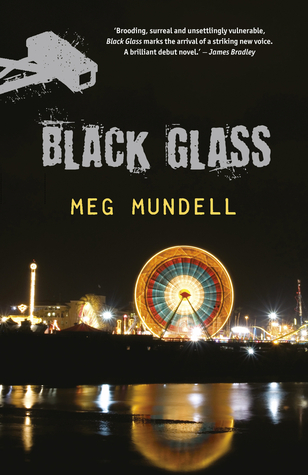
Black Glass by Meg Mundell – review

This review forms part of my contribution to the Australian Women Writers 2013 Reading Challenge. All my 2013 AWWC reviews can be found here.


Black Glass by Meg Mundell

Black Glass by Meg Mundell has been on my reading list for a while. When I was looking through my Kindle to find which book to read next, I picked it more because I’ve had it for a long time than because it leapt out at me.

And I loved it.

So why did it take so long for me to pick up the book? I try to avoid reading detailed reviews of books on my to-be-read list (for fear of spoilers) but I do often glance over high level descriptions to get a feel for whether I’m going to like a book. And I realised that I had internalised two main facts about Black Glass through this vague process of osmosis.

  1. The book was really good (like, award nomination good).
  2. It was a story of two teenage girls trying to find each other in a dystopian Melbourne.

From this (admittedly very small) evidence base, I had put together an image of a technically very good book, a “worthy” novel, that would make me a better person to read, but that I might not actually enjoy. And those kinds of books tend to stay on my to-be-read pile for a long time.

I shouldn’t have hesitated. The book is technically very good and does have interesting things to say, but it is also hugely entertaining.

So, in the interests of providing an alternative view of the book, let me describe it this way. If you like William Gibson (especially the Blue Ant series) and love speculative fiction set in an Australian context, you’re going to like Black Glass.

The structure of the novel seemingly chaotic on the surface, with a conventionally constructed main narrative thread told from the point of view of the two separated sisters (Tally and Grace) interwoven with minor threads told from the point of view of Milk (a man pioneering the art of influencing the mood of a group of people through light, sound and smell) and Damon (a freelance journalist in a world where you’re only as good as your last story). To top it off, small vignettes from a variety of minor or one-off characters, performed in unusual modes (e.g. one sided conversations, surveillance tapes, news snippets etc) illustrate aspects of this future dystopia. It comes together in a chaotic blend, exactly the kind of smart writing that rewards a small investment in adjusting to an unusual narrative style.

Mundell covers some big themes, including the unhealthy manipulation of the citizenry by the media, the dumbing down of journalism, increasing stratification of society into haves and have-nots, government control, familial relationships and survival on the streets when you have no resources to draw on. In some of the scenes that depicted the freelance journalist pitching stories to editors, I detected the scent of personal experience in the journalist’s frustration with people who want “grit” but not “substance” – I wouldn’t be surprised to learn that Mundell herself has some experience in the journalism space.

The main characters are all richly drawn, with distinctive voices (both in terms of dialog and general tone). Mundell invests a lot of energy in creating characters that are both mostly sympathetic (despite their flaws) and compelling. This depth pervades even the more minor character, some of the tragedy that surrounds the character of Blue, for instance, has a strong impact even though the worst of it happens off stage.

The style is reminiscent of Gibson’s work, obviously set in the future, but not the unrecognisable future. Interesting asides on technology, and the different styles of narrative, complete the affect.

This is a strongly character driven piece, sometimes at the expense of the plot. This does result in the pace sometimes dragging a little but this is a minor quibble.

All in all I found Black Glass a thoroughly engaging read. Highly recommended.

I also reviewed this book on Goodreads. View all my reviews.


Creative Commons License
This work by Mark Webb is licensed under a Creative Commons Attribution-ShareAlike 3.0 Australia License.


Bitter Seeds by Ian Tregillis – review

Ion Newcombe, the editor of the excellent Antipodean SF website, recently asked me to review Bitter Seeds by Ian Tregillis. Like the good human being that I am, I immediately did so.

The review is now up in issue 177. Hope you enjoy it!

Note: a copy of the book was provided to me by Antipodean SF. It was free.


Update: I also narrated the review for the latest Antipodean SF podcast (edition 177), it kicks in at about the 44m mark.

Australian Women Writer’s challenge Jan-Feb speculative fiction roundup – link

Tsana Dolichva has done an excellent summary of some of the speculative fiction reviews submitted in January and February for the Australian Women Writers’ challenge 2013. Fantastic idea! She even kindly mentions a couple of my reviews, but don’t hold that against her.

Round up of Ditmar posts

As outlined in a previous post, the Ditmars (Australia’s national speculative fiction awards) are open for nominations for works created in 2012. As well as relying on the excellent Ditmar eligibility wiki, I’ve been keeping track of posts by people I follow around the inter-web as they outline their Ditmar eligibility. If you want a bit more information on any of the authors, publishers and commentators listed below, click through for eligibility goodness (they are listed in the order I came across them). (1)

I’ll be updating this list as more information comes to hand, so be sure to return to the post that is all Ditmar all the time. If you know of any other Ditmar eligibility lists out there, comment below or send through an email with the details and I’ll add it to the list!

Also there are a lot of authors and other creators whose work I’ve enjoyed over the last year but who have not yet published an eligibility list on their blogs. I personally like it when people summarise their award eligibility. Hint, hint.

Notes:

(1) inclusion on this list does not imply any endorsement by me. Hell, I haven’t read half the stuff listed above (too many good things out there for one person to get through in any given year). Just trying to keep track of who is posting about what. Think of this post as a community service.

(2) Simon Petrie has also posted a list of other lists related to the Ditmars, which includes a link to this list. As well as other lists. Which I think makes this a list of lists of posts, as well as a list of posts, to do with the Ditmars.

I’m not sure it can take another layer of recursion.

Ditmars, Galactic Suburbia award and the Stella Prize

A few items of news from the last week or so, all in one handy post!

***

For anyone active in the Australian speculative fiction scene, the annual national SF award, the Ditmars, are now open for nominations. Why not nominate your favourite speculative fiction story or novel by an Australian author from 2012?

The Ditmars also include lots of ancillary categories for fan writing, artist etc. There are a lot of excellent reviewers out there in the Australian scene, such as Sean the Bookonaut or Alex Pierce, that are worth your attention.

Speaking of what to nominate, if like me you don’t remember what was released in 2012, or how long your favourite story was, you can go to the excellent Ditmar eligibility wiki here.

Get your nominating skates on! Nominations can be lodged here.

***

The speculative fiction podcast Galactic Suburbia has given out their annual award for “activism and/ or communication that advances the feminist conversation in the field of speculative fiction in 2012”. And this year the award went to Elizabeth Lhuede for the Australian Women Writers’ Challenge.

Details can be found here, as well as links to the podcast where they announce the award.

I enjoyed my participation in the 2012 challenge, and found it an excellent catalyst for expanding my circle of reading. Congratulations to Elizabeth, a very well deserved award!

***

One of the most frequently reviewed books in the 2012 Australian Women Writers’ challenge, Sea Hearts by Margo Lanagan, has been long listed for the inaugural Stella Prize, a new major literary award for Australian women’s writing. See the full long list here and more details about the prize here.

There have been many reviews of Sea Hearts, including one by yours truly here.

Congratulations Margo!

Fringe – review

Years ago when Fringe started, I watched about 20 minutes of the first episode despite my concerns that Dawson’s Creek was heading to speculative fiction town. There was a plane, people died in mysterious and icky ways and at the 20 minute mark I thought to myself “I can’t commit to another X-Files”. I turned off the TV, rediscovered the lost art of conversation for the evening and felt vaguely relieved that I wasn’t committing myself to yet another television series. Besides, my younger self thought, it probably won’t last more than one season.

The scars of Firefly fandom run deep.

Since then, I’ve heard a scattering of good things about Fringe. Intelligent plots. Good acting not at all reminiscent of Dawson’s Creek. A long running story arc that keeps you engaged. Great characters.

And finally I heard “it’s finishing”.

Aha! I thought. Here’s my chance to get in on this show in the sure knowledge that I can watch the whole damn thing without having to worry about end of season cliffhangers.

What can I say. I think in italics. So, towards the end of last year I purchased the first four seasons on DVD and settled in over the Christmas break to make a dent.

I then proceeded to mainline the first three seasons. My wife complained she never saw me. My children suffered from neglect. Chores went unfulfilled. But finally I finished season 3 and collapsed into a puddle of TV over-watching exhaustion.

Since then I’ve rationed myself to one or two episodes of season 4 per week, partly to help in the recovery process and partly to stretch things out so I can get season 5 before I run out of season 4 episodes.

Because of the ongoing nature of the story, it’s hard to give away much plot without spoiling. Olivia Dunham is an FBI agent who begins to get involved with cases that are a bit weird. She needs Walter Bishop, a brilliant but insane scientist who used to pursue “fringe science” (think telekinesis, teleportation, genetic manipulation etc) and has spent the last 17 years in a mental institution. In order to spring him loose, she enlists the help of Walter’s son, Peter Bishop, an extremely intelligent man with a history of dealing slightly on the wrong side of the law. The three of them solve bizarre mysteries.

So far it sounds a bit X-Files doesn’t it? And reading descriptions like that was what turned me off (as much as I liked the X-Files at the time I didn’t want to repeat the experience). That was a mistake. The storyline for Fringe is much more coherent, with alternative universes, conspiracies and enough sneaky espionage to make a Mission Impossible movie proud.

The characters are wonderful, with fantastic interplay between the three leads (and a fourth regular character, Astrid, an FBI agent who primarily works with Walter in the lab). Olivia is a believable FBI agent, smart and active and even does things like ties her hair back when she is doing actiony stuff (which seems very practical to me). Walter is a brilliant bumbling scientist trying to deal with being back in the “real” world after years in a mental institution. And Peter is great as the sceptic (at least initially), and someone who can get things done outside legal processes.

The ongoing plot line manifests itself in other ways. When a character gets visibly hurt, you see the damage in later episodes, slowly fading over time. There is no reset button here. The plot seems to have been thought through quite well, with threads coming together episodes, sometimes seasons, later.

As you can probably tell, I’ve really enjoyed Fringe and I’m looking forward to seeing how it ends. I’d highly recommend picking it up if, like me, you’ve avoided it for this long.

The Interrogation of Ashala Wolf by Ambelin Kwaymullina – review

This review forms part of my contribution to the Australian Women Writers 2013 Reading Challenge. All my 2013 AWWC reviews can be found here.


 The Interrogation of Ashala Wolf

 The Interrogation of Ashala Wolf is Ambelin Kwaymullina’s first novel. It is based in the far future after a devastating cataclysm has left the world reshaped into a single continent, and the remnants of humanity living in a small number of cities and adhering to a philosophy of Balance to prevent future catastrophes.

Some people are born with special abilities (e.g. the ability to run abnormally fast, turn their dreams into reality, start fires, cause earthquakes etc). These people have been deemed to be a threat to the Balance and are kept in detention camps.

Ashala Wolf is the leader of a tribe of young people with abilities that have escaped detention and live in the wilderness. The story opens with her captured and about to be interrogated for information to help the authorities capture her fellow rebels.

The Interrogation of Ashala Wolf is a young adult piece, so I don’t think I was exactly the target market. For the most part the heroes are young and the villains older, and the story plays out with a strong teenage sensibility.

For all that I wasn’t exactly the intended audience, I enjoyed this novel. The pacing was good, with a lot of action to counter-balance the teenage angst. The writing was clear and crisp and brought me along for the ride smoothly. I finished the book quickly.

I thought the novel had an interesting structure. Without giving spoilers, there is an event part way through the book which casts things in a new light and allowed for the more gradual introduction of information about the broader world in a way that was credible and avoided too much info dumping. There is a lot of use of flash back and memory to tell the story, but it is done in an interesting way.

I enjoyed the references to Australian Aboriginal culture. Because of the near civilisation-ending nature of the cataclysm, there aren’t the same kind of racial divides as there are in contemporary society. However, Kwaymullina makes it clear that Ashala is one of the last descendants of Aboriginal Australia and weaves in Aboriginal mythology into this far future tale. While I can’t comment on the authenticity of the representation, I found it interesting to consider the perspectives on connection to land and people that the book explores.

There are other themes that will resonate with an Australian audience, such as the granting of citizenship, the nature of detention and even the ability to carve out a place for humans in a harsh and unforgiving environment. Both the “normal” society and rebel society have a strong connecting theme of living in harmony with the enivornment, they just disagree what constitutes harmony. Respect for land and the environment pervades every aspect of the story.

While this is the first book in a series, the story is self contained and finishes without invoking a large cliff hanger.

An enjoyable story that I’d have no hesitation in recommending to a young adult audience.

I also reviewed this book on Goodreads. View all my reviews.


Creative Commons License
This work by Mark Webb is licensed under a Creative Commons Attribution-ShareAlike 3.0 Australia License.


GenreCon 2013 – now taking registrations

Regular readers might recall that I attended, and enjoyed very much, GenreCon 2012 late last year. Well, this year it is happening again. GenreCon Australia 2013 will be held in Brisbane in early October.

GenreCon is a more professionally oriented convention aimed more at writers, editors, publishers rather than fans. Last year’s program was excellent – filled with all manner of useful information and interesting speakers.

The organisers have just announced some initial details including the date (11 October through 13 October) and the two initial guests of honour, Chuck Wendig and Anita Heiss.

Registrations are now open and the first 50 will cost only $190. So if you are based in Brisbane or can get there, I highly recommend attending.

Dark Space by Marianne de Pierres – review

Dark Space by Marianne de Pierres

This review forms part of my contribution to the Australian Women Writers 2013 Reading Challenge. All my 2013 AWWC reviews can be found here.


Dark Space is the first of the Sentients of Orion series by Marianne de Pierres. The storyline primarily follows three characters – Baronessa Mira Fedor, a member of the planet Araldis’ aristocracy and born with a genetic makeup that allows her to interact directly with living spaceships, Trinder Pellegrini the spoiled son of Araldis’ planetary ruler and Tekton, an influential citizen of the planet Lostol chosen as a candidate to interact with a recently discovered powerful entity some think is God.

These three point of view characters are interesting selections. All of them are from positions of great wealth and privilege. None of them is particularly sympathetic (although for entirely different reasons). I think the reader is meant to side with Mira, but I found it hard to warm to her.

With three unsympathetic main characters you’d think the story would be in trouble, but the way the storylines interact really works. You see glimpses of the potential for growth in Mira and Trinder, and Tekton is so self centred and devious I found myself cheering for him. So while the characters were not sympathetic, I found them compelling. Just as good in my books.

The world building behind the story was comprehensive and consistent. There is plenty of ground setting in this first book for the rest of the series to build on. The cultures of the various planets and societies referenced, the implications of “humanesque” vs alien sentients and the technology were all well thought through and supported the story.

Italian is not the first culture you expect to see represented in a space opera. This created an interesting point of difference from a lot of other books. The repressed role of women on Araldis provided the source of a lot of the conflict in the novel. It was interesting to think about how some cultural traits that we consider backwards could flourish if the cohort who supports them were to get their own planet.

The plot was enjoyable, with plenty of political intrigue and short bursts of action. Interesting questions were raised and story arcs begun. I’ll certainly be tracking down the rest of the books in the series to see how the story unfolds.

Recommended.

I also reviewed this book on Goodreads. View all my reviews.


Creative Commons License
This work by Mark Webb is licensed under a Creative Commons Attribution-ShareAlike 3.0 Australia License.
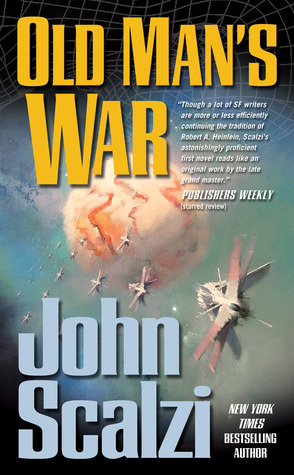
 

Old Man’s War by John Scalzi – review

Old Man's War by John Scalzi

Old Man’s War is the first in the Old Man’s War series of books by John Scalzi. I’ve heard the book mentioned in a lot of different venues and wanted to give it a go before trying some of Scalzi’s later work (including the recent Redshirts whose premise intrigued me).

Old Man’s War is military sci-fi. It is often compared to Robert Heinlein’s Starship Troopers and I can see why that is. Old Man’s War brings a modern sensibility to the same themes (humanity beset by aliens across the galaxy and maintaining a vast military machine just to keep our toehold in space).

Our protagonist, John Perry, has just turned 75. This is the age that citizens of the USA can sign up for the Colonial Defence Force (CDF) and go off planet to serve in humanity’s military. Earth is a separate entity than the Colonies and Earth citizens have virtually no visibility about what happens in the galaxy at large. The Colonies have vastly outstripped Earth in technological terms and earthlings sign up on the assumption that the CDF is going to make them young again to fight as a soldier. Survive for your military term (between 2 and 10 years service) and you get to start life again on a colony somewhere.

This was a good pulp read. The prose was clear and crisp, the ideas were cool and there was a lot of action using whiz bang technology.

I enjoyed the way the world was revealed. As an Earth citizen, John Perry doesn’t know anything more than unsubstantiated rumours about what happens in the Colonies. Seeing events unfold through his eyes allows the back story to be sprinkled across the first third of the book without feeling like you were being subjected to huge amounts of info dumping.

The characters were engaging, but not compelling. I liked the main character, but I must admit I found myself getting annoyed that things seem to keep working out neatly for him. His obstacles were all external, things beyond his control that happened to him. And he meets these challenges in the best possible way every time considering the circumstances. This of course is why he is the hero, but I think I would have found him more relatable if he’d had a flaw or two.

Minor characters are often cannon fodder. It is made very clear from the beginning that life expectancy is not very long as a CDF soldier and Scalzi doesn’t let you forget it. The carnage is comprehensive, and if a new character is introduced it is an even-money bet that their narrative purpose is to die horribly to demonstrate a new way in which the universe is a tough place to be.

Scalzi paints on a large canvas. The galaxy is filled with competitive aliens all vying for the relatively small number of habitable planets (although what consists of “habitable” changes from species to species).  I can see why Scalzi has set a few more books in this world, there is a lot of scope for different stories.

The plot touches on a lot of interesting philosophical points without digging into them in great detail. For instance, in response to a hostile universe, humanity has adopted a “shoot first and ask questions later” approach. This position is challenged briefly in one part of the story, but that thread doesn’t really go anywhere. There is enough to make you think briefly but it stops short of being really crunchy.

However I did find the storyline a good antidote for some of the saccharine stories out there that assume that if we can just understand the “Other” as represented by aliens we would all live in perfect harmony. I imagine that interacting with aliens wouldn’t be like interacting with other Earth based cultures, where there is at least a common genetic and behavioural starting point that comes from evolving together on the same planet. “Kill or be killed” seems just as likely an outcome as “galactic federation”, and I liked reading a book that acknowledges that possibility.

So, all in all an excellent pulp read. I’m likely to read the other books in the series including the recent Human Division which is being released as a weekly serial. I find this interesting as it represents a different way of using the internet and eBooks to engage with an audience. I’ll be watching to see how that goes.

Recommended.

I also reviewed this book on Goodreads. View all my reviews.


Creative Commons License
This work by Mark Webb is licensed under a Creative Commons Attribution-ShareAlike 3.0 Australia License.