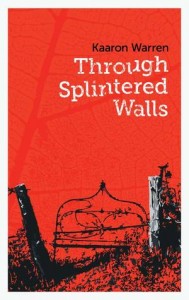
Through Splintered Walls by Kaaron Warren – review

13793120

This review forms part of my contribution to the Australian Women Writers 2012 Reading Challenge. All my 2012 AWWC reviews can be found here.


Through Splintered Walls by Kaaron Warren is one of the Twelve Planets series published by Twelfth Planet Press (12 boutique collections of stories by Australian women writers). It is made up of four shorter stories, including:

  • Mountain
  • Creek
  • Road
  • Sky

Through Splintered Walls is a disturbing collection, which uses an Australian backdrop and seemingly mundane settings and twists them quite savagely in parts. The supernatural elements of all four stories tend towards understatement, with the real horror coming from the behaviour of the characters.

The first three stories (Mountain, Creek and Road) are very short, with the fourth story (Sky) more like novella length and taking up by far the bulk of the book.

Mountain tells the tale of a middle aged woman trapped in a bad domestic situation, encouraged by a ghost to attempt to break the cycle. I enjoyed the non linear nature of the narrative, and the focus on building the protagonist’s character in such a short piece to the point where you entirely believe the choices she makes towards the end.

Creek is a haunting tale of a woman searching for the supernatural cause of a childhood trauma. The protagonist’s inability to form meaningful connections in her life was more tragic than the supernatural elements, again a lovely character piece. There is a line towards the end that mentions nephews and nieces (I won’t quote it in case it spoils anything for anyone) – that line was one of the saddest lines in the book for me, a quite poignant moment of self awareness for the character.

Road is a short piece about an old couple maintaining a refuge for the spirits of road accident victims. Well constructed and written, but it didn’t have the same emotional impact for me as the other stories in the book.

Sky is the longest piece. The story centres mainly around Zed, a nasty piece of work who in a rare moment of guilt decides to try and find out what happened to a childhood school teacher who disappeared years before. His searching leads him to the town of Sky, where being unemployed is not a healthy way of life.

The first few parts of the story move between different point of view characters, which could be disorienting but in this case works really well to build some background to the main story. When we settle on Zed (who provides the point of view for most of the novella) we already have a good sense of him from an external perspective. The switch to first person narrative was an effective way of showing that we were with the “main” point of view character.

There aren’t really any sympathetic characters in the story, but the writing was compelling enough to keep me engaged throughout. The view from inside Zed’s head was particularly well done, with the self justification and self centred nature of a bully and possibly a psychopath drawn out effectively.

The switching between Sky and Canberra as contrasting locations was effective, although my enjoyment of the characterisation of Canberra was probably assisted by my living there for a few years in the early 2000’s. The contrast of the city vs country cultures was also drawn out well.

In many ways Sky reminds me of the novella Wives by Paul Haines in terms of sensibility, unlikeable characters and powerful story telling (although the writing styles are quite different). I found it to be a powerful and memorable piece of writing.

I’ve enjoyed the whole Twelve Planets collection so far, and Through Splintered Walls is another fantastic addition to the series.

Recommended.

I also reviewed this book on Goodreads. View all my reviews.


Creative Commons License
This work by Mark Webb is licensed under a Creative Commons Attribution-ShareAlike 3.0 Australia License.


Cold Days by Jim Butcher – review

Cold Days cover

Look, I like the Dresden Files series. I understand that there are some problematic aspects to the writing, that they don’t subtly explore the human condition and that they don’t extend the genre in innovative new ways.

Don’t care. Hell, I even liked the short lived TV series. (1)

The books are very old fashioned action stories, in a “how much damage can the lead character take and keep on ticking” kind of way. Think Die Hard but with spells.

Cold Days is the 14th book in the Dresden Files series. If you haven’t read any (and this is not the jumping on point if you’re new), Harry Dresden is Chicago’s only wizard for hire. Down and out, unloved by the wizarding establishment, treated with suspicion by the police – the series started with Dresden as a noir style private investigator, with a paranormal twist.

Over the course of 14 books Butcher has steadily raised the stakes and extended the scope of Dresden’s adventures to almost unrecognisable levels. The world building has been extensive, cohesive and in a lot of ways very impressive. The various warring factions are well thought through. I assume Butcher hadn’t mapped out all 14 novels when he started out, but he’s been able to “retro-fit” a lot of world building so the previous stories make more sense as he builds more backstory into the later novels. It would be interesting to go back and read the first couple of novels to see if there are any glaring inconsistencies that time has dulled in my mind. I won’t, because my to-be-read list is scary enough without adding in a Dresden Files re-read. But it would be interesting.

While a few of the more recent Dresden books have felt a bit “papa needs a new swimming pool”, I’ve enjoyed the last couple of books. Butcher shook things up in the last novel (Ghost Story) and the consequences of those changes are still playing out in Cold Days.

There is probably not much point in going through the plot – if you read the Dresden Files you’re going to read the book no matter what I say. If you don’t read the Dresden Files, you should be starting way back towards the beginning.

I did want to comment on the evolution of female characters in the series. The Dresden Files series is told very tightly from Dresden’s point of view, so you don’t get any direct female perspectives. At the start of the series, I felt that the way women were described/characterised was the big flaw of the novels. To be fair Butcher has evolved some very strong and interesting female characters over the years, and the perspective of his protagonist has become a lot less patronising/patriarchal as he has grown. Having said that, Butcher has to have some of the most blatant “male gaze” physical descriptions of female characters I think I’ve ever seen, and that was particularly evident in this novel. I understand that given the point of view character is male and under the influence of some primeval forces in this story in particular, there is some justification. But considering Dresden spends most of the novel taking major beating after major beating, I’m surprised how often he stops to check out someone’s “physical assets”. I wouldn’t have the energy in his position, I’d be too busy saying ‘please stop hurting me’.

Look, high literature it ain’t but I’m always going to grab the latest Dresden Files novel almost as soon as it comes out. If you like your fantasy urban, your action fast paced, your violence uber and your wizards… well, wizardy then this series could be for you. If not, well, there are plenty of other fish in the sea!


(1) Yes Sean I know, even less genre cred points. I must be down below level 10 by now.

I also reviewed this book on Goodreads. View all my reviews.


Creative Commons License
This work by Mark Webb is licensed under a Creative Commons Attribution-ShareAlike 3.0 Australia License.

Australian Women Writers’ challenge 2013

The 2012 Australian Women Writers’ Challenge was an outstanding experience for me. The cause was worthy – challenging the lack of critical attention for Australian women authors. The personal benefits were fantastic – providing the impetus to expand my exposure to interesting authors I hadn’t had the chance to experience

As you can see from my “Mission Accomplished?” post from earlier in the year, I was able to meet the challenge goal of reading and reviewing at least 10 books by Australian women writers. I stuck to the speculative fiction genre. That’s how I roll.

I enjoyed the challenge so much, I’ve decided to give it a go again in 2013. The AWWC website has been revamped and the subscription process much fancier as a result. Inspired by this sophisticated example of web-based renewal I have decided to stretch myself and undertake exactly the same challenge as 2012.

You heard me. Exactly. The. Same.

So I’ll be undertaking the Franklin challenge (read 10 books, review at least 6) and all those books will be in the speculative fiction field. Some may call me stale and unable to embrace change. I view myself as a man on a quest for perfection, willing to put in the hard yards to refine my reviewing art to its most pure and potent form.

If you are inspired by my willingness to scale new heights of reviewing goodness, you should head over to the AWWC 2013 sign up page and join me in another year of spreading the word about some of the great writing by Australian women authors.

Edit 5/1/2014:

My current intended reading list (and status):

  1. Perfections by Kirstyn McDermott – complete: review here
  2. A Trifle Dead by Livia Day – complete: review here
  3. Bluegrass Symphony by Lisa L. Hannett
  4. The Ambassador’s Mission by Trudi Canavan
  5. Bitter Greens by Kate Forsyth
  6. Suited by Jo Anderton – complete: review here
  7. Dark Space by Marianne de Pierres – complete: review here
  8. Winter Be My Shield by Jo Spurrier
  9. The Interrogation of Ashala Wolf by Ambelin Kwaymullina – complete: review here
  10. Black Glass by Meg Mundell – complete: review here
  11. The Accidental Sorcerer by K. E. Mills – complete: review here
  12. Asymmetry by Thoraiya Dyer – complete: review here
  13. New Ceres Nights edited by Alisa Krasnostein and Tehani Wessely – complete: review here
  14. Caution: Contains Small Parts by Kirstyn McDermott – complete: review here
  15. Witches Incorporated by K. E. Mills – complete: review here
  16. Wizard Squared by K. E. Mills – complete: review here
  17. Wizard Undercover by K. E. Mills – complete: review here

Aurealis #56 (November 2012) – review

Aurealis #56 cover

Issue #56 from November 2012 of the Aurealis magazine is a monthly magazine showcasing Australian speculative fiction and with an emphasis on Australian content and news. This edition was edited by Dirk Strasser. This month is a second “Award Winners” editions, with two short stories that won Aurealis Awards this year. This is really the last edition of Aurealis for 2012 (I know, I mistakenly said that last month!), with the publication kicking off again in 2013.

Fittingly, Strasser’s editorial focuses on summing up the 2012 publishing year for Aurealis, including their focus on turning around submissions quickly and highlighting their campaign to become recognised as a professional market by the Science Fiction and Fantasy Writers of America. If they get to 1,000 subscribers they will increase their payments to 5c a word. Go on, you know you want to.

This month’s first award winning story is The Fruit of the Pipal Tree by Thoraiya Dyer, which won the Best Fantasy Short Story award at this year’s Aurealis Awards. The Fruit of the Pipal Tree originally was published in the After the Rain anthology which I have unfortunately not had the pleasure of reading. It is a beautifully written story, with some lovely imagery and well developed characters. My hopefully non spoiler description of the plot is “A scientist travels to a research camp on the Geruwa River in Nepal to attempt to save the suss dolphin from extinction”.

The supernatural elements are kept to the last part in this story, with a very effective build up and skilfully inserted back story combining to make the ending quite powerful.

The second award winner in this month’s edition was The Past is a Bridge Best Left Burnt by Paul Haines, which was part of his collection The Last Days of Kali Yuga (which I have reviewed here) and won the Best Horror Short Story category. Paul Haines sadly passed away from cancer earlier this year before winning the Aurealis. If you are interested in horror then I can’t recommend The Last Days of Kali Yuga strongly enough – it is an extremely powerful collection with writing skill I could only dream of possessing.

Both stories were very worthy of award, and together they make a great edition of Aurealis (as I mentioned last month, purchasing this and issue #55 is a very cost effective way to get exposed to some excellent Australian short fiction).

Crisetta Macleod tantalises us with the thought that we may indeed not be real, using the vehicle of Philip K Dick’s tales to illustrate her points. I have decided, on mature reflection, to proceed as if I am real in my day to day life but I must admit it was touch and go for a while.

There are the normal array of reviews of books. Robert N Stephenson is concerned that North Americans tend to replace decent genre TV shows with mindless crap in his Rants and Raves segment. Rob Parnell calls for more strong roles for women on the big screen in Surfing the Dark Side. And Robert Jenkins both swash and buckles his way through a review of the US TV series Revolution in his The Couch Potato Speaks article (I’ve been giving Revolution a go, but I agree with Rob’s assessment – I just can’t warm to the Gen Y protagonist. Which probably officially makes me old).

As always Carissa’s Weblog provides a round up of some of the more interesting articles around on the web in the area of Australian speculative fiction, mostly in the form of audio interviews and video.

And I said it last time and I’ll say it again – I’ve really enjoyed the Aurealis series of publications through 2012, and I’m looking forward to 2013.


Creative Commons License
This work by Mark Webb is licensed under a Creative Commons Attribution-ShareAlike 3.0 Australia License.


The Emperor’s Soul by Brandon Sanderson – review

  The Emperor's Soul cover

I read this novella on the basis that it was a) by Brandon Sanderson, a writer whose work I have enjoyed b) the subject of a recent episode of the Writing Excuses podcast (which features Sanderson) where they deconstructed the structure and writing choices and c) short.

Sanderson is famous for the rigour and inventiveness of his magic systems and this book is no different. Practitioners in this world are able to adjust the history of an item by the creation of a complicated stamp, and this gives rise to less than scrupulous people being able to create forgeries of famous and/or valuable items.

The story itself is quite engaging although (as is often the case in shorter works) based around a single theme. A master forger is forced to work to forge the soul of the Emperor who has been left as an alive but mindless shell after a botched assassination attempt. The motivations of the Forger as well as the political machinations of the people trying to restore the Emperor made for good context.

The pace was good and combined with the short length made for a quick read.

If you are an aspiring writer, I’d recommend listening to the podcast referenced above after reading. There is an excellent discussion on the technicalities of how the story was constructed, well worth the 15 minutes or so investment (Writing Excuses is a very short weekly podcast, see my Podcasts page for more detail).

A fun, short read. Recommended.

I also reviewed this book on Goodreads. View all my reviews.


Creative Commons License
This work by Mark Webb is licensed under a Creative Commons Attribution-ShareAlike 3.0 Australia License.

Asimov’s Science Fiction – April/May 2012 – review

I have been very lax with my short fiction reading of late, and Asimov’s has suffered accordingly. I finally got back to reading this month, and the April/May 2012 edition was next on my catchup list. The editorial (by Sheila Williams) discussed reader reaction to the digital reading experience and Robert Silverberg’s Reflections talks about the interesting case of a music concert that is not expected to end until 2640. Intrigued? You’ll have to have a read to find out more.

The Last Judgement by James Patrick Kelly is a very interesting novella based on the premise that aliens have removed all men from the planet, leaving only the women. This allows the author to undertake a very interesting exploration of gender, amid a detective noir style setting. I enjoyed the story, it was very readable.

The other novella in this edition was Living in the Eighties by David Ira Cleary which had a different take on time travel. There were the usual paradox hijinks that you’d expect from a time travel story, but the method of travel was somewhat different and it referenced a lot of 80s music etc which I found amusing.

Being a double issue, this edition also contained a novelette Something Real by Rick Wilber. I liked the premise and the characters in this story, set in a series of parallel worlds. The author does a good job creating a character that is very sympathetic and I liked the sense of disorientation around the descriptions of worlds that weren’t quite like ours.

Bonding with Morry by Tom Purdom was a good short piece. I especially liked the protagonist’s reaction to the world around him. The story is a little sentimental in parts (and the author clearly likes engineers, but then who doesn’t?) but hey, I can handle a little sentiment now and then.

Riding Red Ted and Breathing Fire by Carol Emshwiller is a very entertaining story about a man learning about his newly assigned dragon. The voice in this story is excellent, I’d love to try something like it myself. Very amusing but evocative at the same time. Easily my favourite story of the issue.

Also in this issue:

As usual, Asimov’s also contains some poetry including:

  • Book Wyrm by Robert Borski
  • The Music of Particle Physics by Bruce Boston
  • Tachyons by Geoffrey A. Landis
  • Apocalyptic Love Song by Megan Arkenberg

Creative Commons License
This work by Mark Webb is licensed under a Creative Commons Attribution-ShareAlike 3.0 Australia License.

Cracklescape by Margo Lanagan – review

Cracklescape cover

This review forms part of my contribution to the Australian Women Writers 2012 Reading Challenge. All my AWWC reviews can be found here.


Cracklescape by Margo Lanagan is one of the Twelve Planets series published by Twelfth Planet Press (12 boutique collections of stories by Australian women writers). It is made up of four shorter stories, including:

  • The Duchess Dresser
  • The Isles of the Sun
  • Bajazzle
  • Significant Dust

Cracklescape is a beautiful book, with the stylish writing that characterises Lanagan’s work. In some ways it is more literary than genre, where exploration of language and elegant passages and phrases are prioritised over plot. Despite its short length, I do not recommend coming to this book for a quick read. More than one of the stories that I read late at night before going to bed I found myself having to read again with a less sleep deprived brain to make sense of it. For this reason more than anything else, I appreciated and admired Crackescape without loving it.

I recognise that this loses me genre-cred.

The Duchess Dressor tells the story of a share house dweller who finds a duchess dresser by the side of the road. The dresser is cursed/haunted. This opening piece is filled with strong imagery, evoking sadness and quiet desperation with gorgeous prose. I was a little let down by the ending, the story just seemed to peter out.

The Isles of the Sun involves a Pied Piper style engagement of alien/other worldly creatures with a town’s children. The ring leading child Elric was particularly well drawn here, with a distinctive voice and an almost cultish vibe to his engagement with the other children. Switching perspective to the mother for the last part of the story was very effective, and there was an ambiguity to the end which I found very appealing.

Bajazzle was an uncomfortable read. The point of view character Don was very unsympathetic. In fact, all of the characters were unsympathetic but yet the story remained engaging. This story had a bit of raunch in it, which was vividly described and quite visceral.

Significant Dust was probably the least genre of the stories, going back to the early 80s to describe a young woman’s retreat into a lonely existence working in a roadside diner in the Western Australian outback. The backdrop of the story is a UFO encounter, but the story itself doesn’t really have any genre elements. I thought this story was structured very effectively, with interspaced flashbacks that effectively filled in the reason for the lead character’s despair.

I’ve been impressed with the whole Twelve Planets collection so far, and Cracklescape is a worthy addition to the series.

Recommended.

I also reviewed this book on Goodreads. View all my reviews.


Creative Commons License
This work by Mark Webb is licensed under a Creative Commons Attribution-ShareAlike 3.0 Australia License.

Salvage by Jason Nahrung – review

Salvage cover

I didn’t really know what to expect from Salvage by Jason Nahrung published by Twelfth Planet Press. I’ve read and enjoyed Nahrung’s short fiction in a variety of venues, so I knew enough about his preferred genre to assume this novella would be horror. I’d also picked up somewhere that there were vampires involved and it was set on Queensland island (a juxtaposition that sounded interesting), but beyond that nothing. I even avoided reviews from my usual sources so was able to come to the story pretty fresh.

After some of the raw imagery and violence of Nahrung’s other work, I was surprised at how understated and nuanced a story Salvage is. The main character, Melanie, is in a slowly disintegrating marriage. Melanie and her husband Richard have come to a holiday house reminiscent of happier days to work on their marriage. Things aren’t going so well when Melanie meets the mysterious Helena.

The description of a marriage on the rocks was extremely effective, making Melanie’s eventual attraction to Helena very believable. Indeed for a shorter form of fiction, the description of all the main characters was excellent, with Melanie’s development over the course of the story particularly well handled. While I wasn’t able to personally relate to some of the issues Melanie was dealing with, the exploration of the character left me feeling very sympathetic to her plight.

(There is a bit of raunch in the story – if that kind of thing isn’t your cup of tea there will be parts of Salvage that you won’t love).

The setting was richly described, really immersing the reader in isolated tropical splendour. I had wondered how the bright sunshine reputation of Queensland would mesh with dark loving creatures of the night, but the combination of humid heaviness and wild tropical storms was a surprisingly effective backdrop.

The take on the vampire was also unexpected and quite different from what I’ve seen from Nahrung previously. Indeed, I came away from Salvage with a deeper appreciation for Nahrung’s body of work in general. His range is quite excellent and he is rapidly cementing his place as one of my favourite authors.

Nahrung is releasing a novel soon called Blood and Dust, from Australian publisher Xoum. I’ll be virtually lining up for my electronic copy.

Highly recommended.

(Disclaimer: I met Nahrung at a recent conference, and a nicer person you’re not ever likely to meet. I don’t think that fact has influenced my enjoyment of his work, but then again you never know).

I also reviewed this book on Goodreads. View all my reviews.


Creative Commons License
This work by Mark Webb is licensed under a Creative Commons Attribution-ShareAlike 3.0 Australia License.

Aurealis #55 (October 2012) – review

Aurealis #55 cover

Issue #55 is the October 2012 issue of the Aurealis magazine, a monthly magazine showcasing Australian speculative fiction and with an emphasis on Australian content and news. This edition was edited by Dirk Strasser. This month is an “Award Winners” editions, with two short stories that won Aurealis Awards this year. This is the last edition of Aurealis for 2012, with the publication kicking off again in 2013.

Fittingly, Strasser’s editorial focuses on the history of the Aurealis awards and what drove the Aurealis publication to introduce a judged award into the Australian landscape in the first place.

The first award winning story is Rains of la Strange by Robert N. Stephenson. Rains of la Strange was released as a part of the excellent Anywhere But Earth anthology, edited by Keith Stevenson. I reviewed Anywhere But Earth here, where Rains of la Strange was one of the stories I highlighted, particularly for the world building.

The second award winner in this month’s edition was The Short Go: a Future in Eight Seconds by Lisa L. Hannett, from her World Fantasy Award nominated collection Bluegrass Symphony. Given its accolades, Bluegrass Symphony has been on my “to read” list for a while, so it was good to get a chance to “sample” one of the stories.

A fascinating tale, one of those ones that starts off hard to read (the dialect of the narrator is hard to engage with in the first page or so) but before you know it you’re completely enveloped by the story. The pacing was excellent as was the choice in language and imagery. The twist in the story was unexpected and well executed.

Both stories were very worthy of award, and together they make a great edition of Aurealis (if you haven’t read either this is a cost effective way to get exposed to some excellent Australian short fiction).

Crisetta Macleod lets us know what she hates about fantasy, in the appropriately titled article What I Hate About Fantasy. And man, there is a lot she doesn’t like! Some interesting discussion on issues as wide ranging as getting rid of the name “fantasy”, through to the need to give fantasy novels ratings where they deal with adult themes such as torture, through to the tendency to use magic as a deus ex machina (i.e. to solve a plot problem). Interesting comments from an experienced reviewer, well worth a read.

Crisetta Macleod also gave a run down on Conflux 2012, the Canberra speculative fiction convention. Sounds like a fantastic time was had by all – my lack of attendance has made me jealous.

There are the normal array of reviews of books. Robert N Stephenson decries the loss of quality in the writing field in his Rants and Raves segment. Rob Parnell decries the loss of originality in the superhero movie genre in Surfing the Dark Side. And Robert Jenkins decries the loss of quality in TV with his review of Sinbad (the UK TV series) in his The Couch Potato Speaks article. A poor quality trifecta!

As always Carissa’s Weblog provides a round up of some of the more interesting articles around on the web in the area of Australian speculative fiction, mostly in the form of audio interviews and video.

I’ve really enjoyed the Aurealis series of publications through 2012, and I’m looking forward to 2013.


Creative Commons License
This work by Mark Webb is licensed under a Creative Commons Attribution-ShareAlike 3.0 Australia License.


Aurealis #54 (September 2012) – review

Aurealis #54 coverIssue #54 is the September 2012 issue of the Aurealis magazine, a monthly magazine showcasing Australian speculative fiction and with an emphasis on Australian content and news. This edition was edited by Michael Pryor.

Pryor’s editorial focuses on the passing of Neil Armstrong and the interaction between space exploration and science fiction.

The first story in this month’s edition is Anvil of the Sun by Karen Maric. A tale of bloody revenge set in a fantasy setting, the world building behind this short piece was very good. It felt like an introduction to a universe that Maric intends to do more work in. The writing was very good, with a strong sensory immersion into the harsh landscape the characters inhabit.

Running Wild by Jack Nicholls tells the tale of a suburban prank that takes a turn into the surreal. I loved the point of view character’s perspective in this story, and the description of the backyard world of suburbia was excellent (while simultaneously reminding me why I prefer a more urban existence).

This month’s edition also contains a very interesting interview with Trudi Canavan, by Crisetta Macleod. The interview covers everything from the rise of eBooks, to the exploration of social issues in Canavan’s books and the combination of creative endeavours that Canavan involves herself in.

There are the normal array of reviews of books (including Canavan’s latest The Traitor Queen). Rob Parnell’s Surfing the Dark Side explores why horror fans can love a truly bad horror movie, and Robert Jenkins reviews one of my favourite TV series at the moment Grimm in his The Couch Potato Speaks segment.

As always Carissa’s Weblog provides a round up of some of the more interesting articles around on the web in the area of Australian speculative fiction, mostly in the form of audio interviews and video.

Well worth the read.


Creative Commons License
This work by Mark Webb is licensed under a Creative Commons Attribution-ShareAlike 3.0 Australia License.