So… many… award… lists…

Work has kept me a bit busy over the last couple of weeks, so I haven’t had a lot of time to add to the blog. In that time, three different sets of Australian award nominations have come out (in chronological order of release):

  1. 2012 Aurealis Awards
  2. 2012 Australian Shadow Awards
  3. 2013 Ditmars

I’m not going to repeat all the nominations here (follow the links above), but I did want to draw out a few highlights.

Firstly, Kirstyn McDermott and Jason Nahrung have cemented their place as the Australian speculative fiction writing power couple by securing nominations in all three awards. In previous posts I’ve expressed my love for their recent work, PerfectionsBlood and Dust and SalvageAll three appear in this year’s awards, which is especially impressive considering Perfections and Blood and Dust were only released just before Christmas 2012.

Secondly, Sean Wright (or Sean the Bookonaut) is up for several Ditmars in the fan writing/publications sections. Sean is an excellent contributor to the Australian speculative fiction scene, made even more impressive by the fact that he does it all from a secret (1) rural South Australian location with dodgy internet connections. If you’ve not come across his work before, it is well worth your time to track down his site and podcast.

Thirdly, Antipodean SF (who published a few of my flash fiction pieces last year) are up for best fan publication in the Ditmars. It is amazing how many established writers I talk to who say “Oh, yes – Antipodean SF is where I got my first story published”. Ion Newcombe is an excellent editor and generous contributor to the Australian speculative fiction scene. If you’ve never seen Antipodean SF, I’d encourage you to check the site out. (2)

Finally, I really enjoyed Kaaron Warren‘s collection Through Splintered Walls last year. I can see the stories from this book (and the collection itself) sprinkled all through these awards list. A fantastic book, well worth checking out.

I’ve decided that after I’ve finished my current reading, I’m going to make a concerted effort to plug some of the gaps in my Australian reading using these award lists as a guide. What about you? Have you read much of the work doing the rounds in this year’s awards season? Anything stand out?


(1) The secret thing may not be entirely factually accurate

(2) I help out preparing the e-Book edition of Antipodean SF each month, so I’m not entirely without bias here.

Day jobs and writing

“Day jobs and writing” was the subject of a recent thread on a writing mailing list I subscribe to. It was interesting reading about how a lot of people struggle with a job that lets them pay the bills, but takes them away from their first love, writing. There was a lot of dreaming of the day when they could chuck the day job and write full time. I threw my $0.02 in, and I thought I might repeat some of the sentiments here.

I love my day job. I work in the public sector (government work), and get a great sense of satisfaction out of serving the society I live in. My day job does not involve large amounts of writing, and what writing there is takes the form of briefing notes etc. The job is very demanding in terms of hours which makes it hard to fit in writing. I also have chosen to live within walking distance of my work, so no commute time to do writing (but with an hour and a half of walking each day, plenty of time to think about writing!). I have a young family – so difficult to fit writing around family activities. I do wish I had more time for writing.

However, I do not aspire to be a full time writer.

I’ve only been writing for a couple of years (late starter – I blame the mid life crisis) and I always felt obscurely guilty about the fact I didn’t want to be a full time writer. I went to a few writing courses and conventions, and there was a lot of attitude that translated to “if you are serious about your craft, your goal has to be to be a full time writer. Therefore if you don’t aspire to full time writer status, you can’t be a ‘real’ writer”. It was a bit depressing – I began to feel that I didn’t “belong” in the writing community.

Then I went to a panel session at the excellent GenreCon in Sydney Australia late last year and there was a writer that I admire saying that he loves writing, that he is absolutely serious about his craft, that he always wants to improve, that he loves being published but that he didn’t want to be a full time writer.

He loved his day job. He loved not feeling commercial pressure to make money from writing and the creative freedom that offered him. That he hoped to “break even” on his writing, but that his writing business plan had at its goal being a part time writer.

I felt good after that session, let me tell you.

So, I love my day job. I love writing. Long may they both live!

What about you?

NSW Speculative Fiction Festival 2013

Yesterday (Saturday 16th March) I attended the second NSW Speculative Fiction Festival at the NSW Writers’ Centre.

I started off badly, having somehow got it into my head that the day started at 10:30am. I turned up to a full car park, but couldn’t find any people. Imagine the fierceness of my blushing when I realised everyone was in the first session, which had been going for over 1/2 hour. I decided to wait for the second session to save the stinging embarrassment of entering 5 minutes before the end. It also let me pre-order my lunch. Win-win in my books.

My second problem came when the lovely people manning the front desk realised my badge had been taken! An impostor was roaming the rooms of the festival, having stolen my identity and slipped comfortably into the persona of a complete neophyte writer with no paid publications to his name.

Wait, why would someone do that?

I was assured that they had seen my badge that very morning, but now it was nowhere to be found. A hastily constructed replacement around my neck, I set forth to conquer the festival.

But I kept an eye on every name badge I passed, I can tell you.

So, the second session of the day and the first I attended was titled Publishing Into the Future, chaired by Russell Farr (of Ticonderoga Press) with panel members Zoe Walton (Random House Australia), Joel Naoum (Momentum) and Dionne Lister. The general answer to the question “what is the future of publishing” seemed to be “buggered if we know”, but there was some interesting exploration of the mix of publishing options and a general expectation that the book would survive, in some form or another. Phew. I enjoyed the panel, although some answers were a little verbose, I think they could have covered a lot more ground in the time available. That being said, there was some interesting reflections on the changes in marketing that have accompanied the rise of the eBook. If I ever publish a novel in eBook only format, I’ll have a lot to think about.

I also got to hear Joel Naoum’s theory relating interactive books to masturbation. I can’t do it justice. Next time you’re talking with him, bring it up.

The second panel, The Allure of Epic Fantasy, was chaired by Ian Irvine and included Melina Marchetta, Pamela Freeman and Garth Nix (a last minute substitute for Duncan Lay). The panel ended up focusing more on the authors writing style (plotter vs pantster) and their general approach to writing. Garth Nix was a very polished presenter (obviously gets a lot of practice). Actually, all four panelists were excellent in this session, and while it was only tangentially covering epic fantasy, I found this the “inspiring” session of the day.

All inspired, I then enjoyed lunch with the inimitable Lynda Young. Lyn has been a great support to me in my writing and I always enjoy the chance to catch up. Lyn had a story published in a US based anthology (Make Believe) last year, and I really enjoyed hearing about her experiments in marketing in that environment (I had to admit that while I bought the anthology and read her story just after it was released, I hadn’t quite got to the other stories in the anthology and so hadn’t done a review on this website. Bad writing friend. Must fix that as quickly as possible).

Towards the end of lunch we were joined by Patrick Keuning, a relatively new writer who has recently got his first paid publication with a story in the new In-Fabula Divino anthology. Patrick was (justifiably) as pleased as punch, and I saw him actively promoting the book throughout the day. He has documented his experience of the day on his website, go and have a look to hear more! Rick has also provided excellent feedback on my work in the past, I’m looking forward to seeing more of his writing in the future.

After lunch I attended Oh the Horror! The Future of Weird Fiction. I was excited about this panel, it contained three of my favourite authors – Deborah Biancotti, Kirstyn McDermott and Jason Nahrung. Actually, now I’m worried that the fourth member of the panel, Robert Hood, might feel left out. Robert, I know you probably read the blog. I have to admit I haven’t had the pleasure of reading your work as yet. But I’m sure you would be one of my favourite writers if I had, based on nothing other than the company you keep.

In any case, I digress (did someone mention “too verbose” earlier in this blog? Friends, let’s not quibble). The panel tried to define “horror”, in contrast with “weird”. I really liked Nahrung’s characterisation – horror tries to take something known and make it unknown and leave the reader unsettled, while weird tries to take something known and make it unknown, but leave the reader with a sense of wonder (he said it better than that, but that is why he is a name brand author and I’m writing this blog post).

A very interesting dissection of the broad horror genre ensued. Horror is one part of the speculative fiction spectrum that I’ve struggled to grapple with and I always like the chance to hear skilled practitioners debate the craft.

This session was also notable because in it, while listening to a brief aside about the atheist nature of zombies, I was suddenly struck with a new angle to a story I’ve been struggling with for ages. I really liked the angle as well. To be honest, I would have considered the whole day a success just for that. Good times.

In any case, I ended that session suitably creeped out.

The next session I attended was Short and Not So Sweet: writing and publishing short fiction, chaired by Cat Sparks and including Angela Slatter, Lisa Hannett and Dirk Strasser. An interesting discussion on the short story market was had, with some great thoughts on whether we were on the edge of another short story boom as people seek out bite-sized content to consume on the go. There was universal agreement that one should start submitting to the pro-markets immediately, but I did keep in mind that this was a group of multi-award winning short story writers. With their skills, I’d probably focus on the pro markets as well. I’m pretty sure there are no awards in my near future, but still the advice to aim high is good advice.

As an aside, Cat Sparks (who is the fiction editor at Cosmos, which is a pro market) noted the lack of Australian submissions to her publication. I thought to myself “Well, she’ll get a few more on the back of saying that“, but I notice that Cosmos is currently closed for submissions. As is Aurealis, where fellow panel member Dirk Strasser holds court. I suspect there are a lot of disappointed newbie writers out there today!

I popped out to stretch my legs before the last session, and bumped into Jason Nahrung. We started chatting about his new book (Blood and Dust, which I reviewed here and is available from Amazon or at the publisher Xoum’s website). It was an interesting conversation, covering everything from the challenges of marketing in the eBook world, through to my experience of reading Blood and Dust and even Jason’s process in working on his next novel (which I’m very excited about!). In fact, it was so interesting that I completely forgot to attend the last session of the day. Oops. I’m sure others have covered in admirably in other blogs.

Some further brief but interesting chats with Ben Chandler on his role in evaluating grant applications in South Australia and Richard Harland on his upcoming steampunk release (Song of the Slums). Before I knew it, the book launch of Prickle Moon by Juliet Marillier from Ticonderoga Press had started. So over a glass of red, I had the pleasure of listening to some excellent readings and general discussion of the book.

Sadly, it being after 6:00pm and my wife having been stuck with enjoyed the company of the children all day, I had to head off. Just like last time, I found the festival to be a great re-charger of my enthusiasm batteries. I look forward to many more.

Next stop – Conflux.

Oh, and I never did find my doppelgänger.


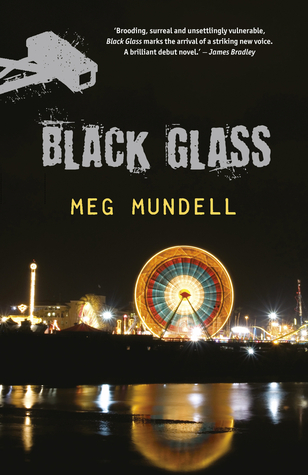
Black Glass by Meg Mundell – review

This review forms part of my contribution to the Australian Women Writers 2013 Reading Challenge. All my 2013 AWWC reviews can be found here.


Black Glass by Meg Mundell

Black Glass by Meg Mundell has been on my reading list for a while. When I was looking through my Kindle to find which book to read next, I picked it more because I’ve had it for a long time than because it leapt out at me.

And I loved it.

So why did it take so long for me to pick up the book? I try to avoid reading detailed reviews of books on my to-be-read list (for fear of spoilers) but I do often glance over high level descriptions to get a feel for whether I’m going to like a book. And I realised that I had internalised two main facts about Black Glass through this vague process of osmosis.

  1. The book was really good (like, award nomination good).
  2. It was a story of two teenage girls trying to find each other in a dystopian Melbourne.

From this (admittedly very small) evidence base, I had put together an image of a technically very good book, a “worthy” novel, that would make me a better person to read, but that I might not actually enjoy. And those kinds of books tend to stay on my to-be-read pile for a long time.

I shouldn’t have hesitated. The book is technically very good and does have interesting things to say, but it is also hugely entertaining.

So, in the interests of providing an alternative view of the book, let me describe it this way. If you like William Gibson (especially the Blue Ant series) and love speculative fiction set in an Australian context, you’re going to like Black Glass.

The structure of the novel seemingly chaotic on the surface, with a conventionally constructed main narrative thread told from the point of view of the two separated sisters (Tally and Grace) interwoven with minor threads told from the point of view of Milk (a man pioneering the art of influencing the mood of a group of people through light, sound and smell) and Damon (a freelance journalist in a world where you’re only as good as your last story). To top it off, small vignettes from a variety of minor or one-off characters, performed in unusual modes (e.g. one sided conversations, surveillance tapes, news snippets etc) illustrate aspects of this future dystopia. It comes together in a chaotic blend, exactly the kind of smart writing that rewards a small investment in adjusting to an unusual narrative style.

Mundell covers some big themes, including the unhealthy manipulation of the citizenry by the media, the dumbing down of journalism, increasing stratification of society into haves and have-nots, government control, familial relationships and survival on the streets when you have no resources to draw on. In some of the scenes that depicted the freelance journalist pitching stories to editors, I detected the scent of personal experience in the journalist’s frustration with people who want “grit” but not “substance” – I wouldn’t be surprised to learn that Mundell herself has some experience in the journalism space.

The main characters are all richly drawn, with distinctive voices (both in terms of dialog and general tone). Mundell invests a lot of energy in creating characters that are both mostly sympathetic (despite their flaws) and compelling. This depth pervades even the more minor character, some of the tragedy that surrounds the character of Blue, for instance, has a strong impact even though the worst of it happens off stage.

The style is reminiscent of Gibson’s work, obviously set in the future, but not the unrecognisable future. Interesting asides on technology, and the different styles of narrative, complete the affect.

This is a strongly character driven piece, sometimes at the expense of the plot. This does result in the pace sometimes dragging a little but this is a minor quibble.

All in all I found Black Glass a thoroughly engaging read. Highly recommended.

I also reviewed this book on Goodreads. View all my reviews.


Creative Commons License
This work by Mark Webb is licensed under a Creative Commons Attribution-ShareAlike 3.0 Australia License.


Zombie flash fiction competition entry – intrigued?


A writing friend, P J Keuning, is new to the field but displayed mad newbie writing skills and had one of his short stories published in the just-released anthology In Fabula-Divino. To support his introduction to published glory, I’ve been following the release activities for the book. One of the authors, Holly Kench, is running a zombie flash fiction competition to celebrate the launch.

I was reading an entry when the following very short story occurred to me.

Edit 5/5/2013

I’ve removed the story temporarily as I’ve submitted it to a flash fiction site. Will put it back up if the story is rejected. Or you can write to me and ask for a copy!

Edit 23/5/2013

My zombie story, Hindsight is a Bitch, has been accepted by Antipodean SF for publication. Look for it in issue 185, due out in November 2013.

Bitter Seeds by Ian Tregillis – review

Ion Newcombe, the editor of the excellent Antipodean SF website, recently asked me to review Bitter Seeds by Ian Tregillis. Like the good human being that I am, I immediately did so.

The review is now up in issue 177. Hope you enjoy it!

Note: a copy of the book was provided to me by Antipodean SF. It was free.


Update: I also narrated the review for the latest Antipodean SF podcast (edition 177), it kicks in at about the 44m mark.

Australian Women Writer’s challenge Jan-Feb speculative fiction roundup – link

Tsana Dolichva has done an excellent summary of some of the speculative fiction reviews submitted in January and February for the Australian Women Writers’ challenge 2013. Fantastic idea! She even kindly mentions a couple of my reviews, but don’t hold that against her.

Round up of Ditmar posts

As outlined in a previous post, the Ditmars (Australia’s national speculative fiction awards) are open for nominations for works created in 2012. As well as relying on the excellent Ditmar eligibility wiki, I’ve been keeping track of posts by people I follow around the inter-web as they outline their Ditmar eligibility. If you want a bit more information on any of the authors, publishers and commentators listed below, click through for eligibility goodness (they are listed in the order I came across them). (1)

I’ll be updating this list as more information comes to hand, so be sure to return to the post that is all Ditmar all the time. If you know of any other Ditmar eligibility lists out there, comment below or send through an email with the details and I’ll add it to the list!

Also there are a lot of authors and other creators whose work I’ve enjoyed over the last year but who have not yet published an eligibility list on their blogs. I personally like it when people summarise their award eligibility. Hint, hint.

Notes:

(1) inclusion on this list does not imply any endorsement by me. Hell, I haven’t read half the stuff listed above (too many good things out there for one person to get through in any given year). Just trying to keep track of who is posting about what. Think of this post as a community service.

(2) Simon Petrie has also posted a list of other lists related to the Ditmars, which includes a link to this list. As well as other lists. Which I think makes this a list of lists of posts, as well as a list of posts, to do with the Ditmars.

I’m not sure it can take another layer of recursion.

Ditmars, Galactic Suburbia award and the Stella Prize

A few items of news from the last week or so, all in one handy post!

***

For anyone active in the Australian speculative fiction scene, the annual national SF award, the Ditmars, are now open for nominations. Why not nominate your favourite speculative fiction story or novel by an Australian author from 2012?

The Ditmars also include lots of ancillary categories for fan writing, artist etc. There are a lot of excellent reviewers out there in the Australian scene, such as Sean the Bookonaut or Alex Pierce, that are worth your attention.

Speaking of what to nominate, if like me you don’t remember what was released in 2012, or how long your favourite story was, you can go to the excellent Ditmar eligibility wiki here.

Get your nominating skates on! Nominations can be lodged here.

***

The speculative fiction podcast Galactic Suburbia has given out their annual award for “activism and/ or communication that advances the feminist conversation in the field of speculative fiction in 2012”. And this year the award went to Elizabeth Lhuede for the Australian Women Writers’ Challenge.

Details can be found here, as well as links to the podcast where they announce the award.

I enjoyed my participation in the 2012 challenge, and found it an excellent catalyst for expanding my circle of reading. Congratulations to Elizabeth, a very well deserved award!

***

One of the most frequently reviewed books in the 2012 Australian Women Writers’ challenge, Sea Hearts by Margo Lanagan, has been long listed for the inaugural Stella Prize, a new major literary award for Australian women’s writing. See the full long list here and more details about the prize here.

There have been many reviews of Sea Hearts, including one by yours truly here.

Congratulations Margo!

Fringe – review

Years ago when Fringe started, I watched about 20 minutes of the first episode despite my concerns that Dawson’s Creek was heading to speculative fiction town. There was a plane, people died in mysterious and icky ways and at the 20 minute mark I thought to myself “I can’t commit to another X-Files”. I turned off the TV, rediscovered the lost art of conversation for the evening and felt vaguely relieved that I wasn’t committing myself to yet another television series. Besides, my younger self thought, it probably won’t last more than one season.

The scars of Firefly fandom run deep.

Since then, I’ve heard a scattering of good things about Fringe. Intelligent plots. Good acting not at all reminiscent of Dawson’s Creek. A long running story arc that keeps you engaged. Great characters.

And finally I heard “it’s finishing”.

Aha! I thought. Here’s my chance to get in on this show in the sure knowledge that I can watch the whole damn thing without having to worry about end of season cliffhangers.

What can I say. I think in italics. So, towards the end of last year I purchased the first four seasons on DVD and settled in over the Christmas break to make a dent.

I then proceeded to mainline the first three seasons. My wife complained she never saw me. My children suffered from neglect. Chores went unfulfilled. But finally I finished season 3 and collapsed into a puddle of TV over-watching exhaustion.

Since then I’ve rationed myself to one or two episodes of season 4 per week, partly to help in the recovery process and partly to stretch things out so I can get season 5 before I run out of season 4 episodes.

Because of the ongoing nature of the story, it’s hard to give away much plot without spoiling. Olivia Dunham is an FBI agent who begins to get involved with cases that are a bit weird. She needs Walter Bishop, a brilliant but insane scientist who used to pursue “fringe science” (think telekinesis, teleportation, genetic manipulation etc) and has spent the last 17 years in a mental institution. In order to spring him loose, she enlists the help of Walter’s son, Peter Bishop, an extremely intelligent man with a history of dealing slightly on the wrong side of the law. The three of them solve bizarre mysteries.

So far it sounds a bit X-Files doesn’t it? And reading descriptions like that was what turned me off (as much as I liked the X-Files at the time I didn’t want to repeat the experience). That was a mistake. The storyline for Fringe is much more coherent, with alternative universes, conspiracies and enough sneaky espionage to make a Mission Impossible movie proud.

The characters are wonderful, with fantastic interplay between the three leads (and a fourth regular character, Astrid, an FBI agent who primarily works with Walter in the lab). Olivia is a believable FBI agent, smart and active and even does things like ties her hair back when she is doing actiony stuff (which seems very practical to me). Walter is a brilliant bumbling scientist trying to deal with being back in the “real” world after years in a mental institution. And Peter is great as the sceptic (at least initially), and someone who can get things done outside legal processes.

The ongoing plot line manifests itself in other ways. When a character gets visibly hurt, you see the damage in later episodes, slowly fading over time. There is no reset button here. The plot seems to have been thought through quite well, with threads coming together episodes, sometimes seasons, later.

As you can probably tell, I’ve really enjoyed Fringe and I’m looking forward to seeing how it ends. I’d highly recommend picking it up if, like me, you’ve avoided it for this long.