Aurealis Awards 2013

Had a fantastic time at the Aurealis Awards last night, lots of catching up with people, lots of excellent speculative fiction rewarded, lots of alcohol imbibed by others making me seem more interesting than I actually am. Who can ask for more?

The remote summary dejour is looking at Sean the Bookonaut’s Storify record of any given event, and this year’s Aurealis Awards is no different. You can find the summary here.

But now for some more personal reflections on the evening.

I got a chance to catch up with Nuke from Antipodean SF where I received the first ever face to face acceptance of a story that Nuke has ever given for my recently submitted piece Hindsight is a Bitch. It’s one of the shortest short stories I’ve ever written. Thanks Nuke! I could see Nuke was busily running around with his recorder, so we can expect lots of sound bites from various speculative fiction luminaries in future editions of the Antipodean SF podcast.

I also caught up with Rick (Patrick Keuning), a similar stage writer to me who was recently published in the excellent In Fabula-Divino anthology. You can follow Rick’s writing exploits on his website.

I had a good chance to chat with Jason Nahrung (whose excellent Blood and Dust and Salvage were up for best horror novel) and Kirstyn McDermott (whose excellent Perfections won best horror novel). While I was very pleased for Kirstyn’s win, I’d kind of been hoping for some kind of tie between her and Jason – I loved Blood and Dust especially. The only solution to my dilemma is for everyone reading this to immediately go out and buy all of Jason and Kirstyn’s work. If they can’t have joint awards, they should be able to console themselves by healthy joint bank balances. Go on, buy the books already! (1)

Lots of other brief conversations, including hearing about the contractual trickiness of being a creative writing academic by Lisa L. Hannett, finding an unexpected day job connection with Keith Stevenson, meeting Thoraiya Dyer in the flesh then utterly failing to talk to her properly (she was whisked away by Nuke for an Antipodean SF interview), picking up my copy of Robert Hood’s latest book after they ran out at Conflux and swapping high school sports war stories with Kirstyn McDermott and Jason Franks.

The ceremony itself was good. Scott Westerfeld was an excellent MC, giving a great introductory speech and keeping things moving at a fair clip. At last year’s awards, nearly everyone got up and said “oh dear I haven’t prepared anything, this is so unexpected”, which I think detracted from the ceremony. This year most people seemed to have learnt from that experience, because there were many more short, gracious and most of all prepared acceptances. I particularly liked Jonathan Strahan’s “insert winning publication here” speech which someone read out for him in absentia (he had three of the 5 nominations in that category). Margo Lanagan’s shout out to her husband was also a highlight.

The ceremony also included the screening of a short film by Nick Stathopoulos and director Ryan Cauchi, “It Grows” which was very entertaining.

So, I’ve listed the short lists below with the winning entry highlighted in green. I’ve included in the commentary links to any reviews I’ve done on works (it seems I am woefully under-read in award nomination worthy Australian speculative fiction this year!).

-m

(1) Actually, I don’t think I quite have the readership to send Scrouge McDuck level money in their direction. I’ll have to think of a Plan B.

Edit 22/5/2013:

Some excellent photos of the event by Cat Sparx here.

***

Best Science Fiction Novel

Best Science Fiction Short Story

Best Fantasy Novel

Best Fantasy Short Story

Best Horror Novel

Best Horror Short Story

Best Young Adult Novel

Young Adult Short Story

  • “Stilled Lifes x 11″, Justin D’Ath (Trust Me Too)
  • “The Wisdom of Ants”, Thoraiya Dyer (Clarkesworld 12/12)
  • “Rats”, Jack Heath (Trust Me Too)
  • “The Statues of Melbourne”, Jack Nicholls (Andromeda Spaceways Inflight Magazine 56)
  • “The Worry Man”, Adrienne Tam (self-published)

Best Collection

  • The Book Your Mad Ancestor Wrote, K.J. Bishop (self-published)
  • Metro Winds, Isobelle Carmody (Allen & Unwin)
  • Midnight and Moonshine, Lisa L. Hanett & Angela Slatter (Ticonderoga)
  • Living With the Dead, Martin Livings (Dark Prints)
  • Through Splintered Walls, Kaaron Warren (Twelfth Planet) (My review of Through Splintered Walls)

Best Anthology

  • The Year’s Best Australian Fantasy and Horror 2011, Liz Grzyb & Talie Helene, eds. (Ticonderoga Publications)
  • Bloodstones, Amanda Pillar, ed. (Ticonderoga)
  • The Best Science Fiction and Fantasy of the Year: Volume 6, Jonathan Strahan, ed. (Night Shade)
  • Under My Hat, Jonathan Strahan, ed. (Random House)
  • Edge of Infinity, Jonathan Strahan, ed. (Solaris)

Best Children’s Fiction (told primarily through words)

Best Children’s Fiction (told primarily through pictures)

Best Illustrated Book/Graphic Novel

There was also the Peter McNamara Convenors’ Award, which this year went to Kate Eltham who has been active in speculative fiction for some time, especially in Queensland. The Kris Hembury Encouragement Award went to Laura Goodin.
The Regersek Zone to be published on Antipodean SF

It’s been a long time between publications. A few “life gets in the way” events late last year really threw me out of the writing zone. That, combined with my attempts to write some longer-short pieces, has meant it is a long time since my last story made its way out into the world. As a result, I am ridiculously happy that Nuke (the editor at Antipodean SF) has accepted one of my flash fiction pieces for publication.

The Regersek Zone is currently scheduled for issue 184 of Antipodean SF, published in October 2013. I’ll also record a reading for the radio show/podcast, which will be broadcast some time in October/November.

I know Nuke is always looking for new material for the Antipodean SF website, so if you fancy trying your hand at a short piece of speculative flash fiction you should check out the Antipodean SF submissions page.

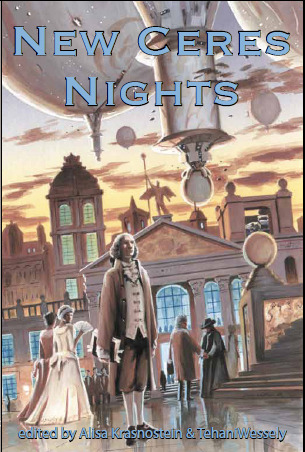
New Ceres Nights edited by Alisa Kranostein and Tehani Wessely – review

This review sort of forms part of my contribution to the Australian Women Writers 2013 Reading Challenge. All my proper 2013 AWWC reviews can be found here.

I don’t think I can officially claim this as an Australian Women Writer’s challenge book, as only 6 out of the 13 stories are penned by Australian women. However, it show the work of many of Australian speculative fiction’s current batch of award winning female authors (think Kaaron Warren, Angela Slatter, Thoraiya Dyer, Sue Isle, Tansy Rayner Roberts, Sylvia Kelso), so I’ll probably promote this through AWW channels.

And in my mind I’ll count it as a 1/2 contribution to my target.


New Ceres Nights

New Ceres Nights was published in 2009 by Twelfth Planet Press. The premise of the anthology is that the stories are all set in the shared world of New Ceres, a planet in the outer colonies that has embraced (and ruthlessly enforces) an 18th century way of life. Apart from a single spaceport connecting it to the rest of the human race, the technological level of the whole planet has been wound back.

I found the background to this anthology interesting. The introduction by New Ceres Board members Tansy Rayner Roberts and Dirk Flinthart, tells of a world built by an online community of mainly Australian speculative fiction writers, artists and fans. This was a bit before my time (as regular readers of this blog know I have only been involving myself in the Australian spec fic scene for the last year or two), but it seems like a fascinating experiment in using the internet to build community.

As far as I can tell, the New Ceres project is gone (all links seem to lead to dead-ends and defunct sites), so reading this anthology feels like a glimpse into a now departed phase of Australian speculative fiction history. A few other artefacts survive (such as the book Angel Rising by Dirk Flinthart) as well as some cryptic references to an eZine, but that is about it.

It’s too bad – I liked what I’ve read so far. It would have been fascinating to have a look at all the shared “source material” as well just to see how the world was constructed. It reminds me of a recent Kickstarter the Massive Fiction Project, which is aiming to build a shared world for fiction writing. I’m interested in these kinds of endeavours and constructs, would have been great to see an Australian attempt.

If any reader of this article was involved in the New Ceres shared world experience, I’d love to hear from you in the comments section below.

Anyway enough tangental musings, why don’t we return to the actual book. From the back blurb: “New Ceres Nights presents thirteen exciting stories of rebellion, debauchery, decadence, subterfuge and murder, set against the backdrop of powdered wigs, coffee houses, balls and duels”.

The mixture of 18th century limitations and illicit high technology made a surprisingly powerful combination, reminiscent of some of the better steampunk stories I’ve read. All the stories were quite good, I can’t really call out one I didn’t like. As is my habit, I’ll only comment on those stories where I have something to say – which is no reflection on the other stories of course!

  • The first story of the collection, Debutante by Dirk Flinthart, gives a very effective introduction to the world of New Ceres. Set somewhat before the rest of the anthology, it is an origins story of a sort. Flinthart’s dialogue is particularly sharp, and the ending to this tale gives you a real sense of the tone of the collection.
  • The contrast between the first story and the second (The Widow’s Seven Candles by Thoraiya Dyer) is quite stark, as the reader is thrown from a relatively hi-tech scenario to a very low tech one. Dyer’s writing is very engaging, and she creates a very sympathetic lead character in the candlemaker Etienne.
  • Murder in Laochan by Aliette de Bodard was notable in its use of a non-European 18th century backdrop. I also quite liked the conceit behind the main character, and found the story a delight to read.
  • Speaking of interesting conceits, Tontine Mary by Kaaron Warren (whose work I have been enjoying a lot of late) draws on an actual feature of 18th century life, the tontine. A tontine is essentially a lottery, where a group of people put in money and the last surviving member gets it all. Warren captures the life of the title character marvellously, so much so that her parting “gift” to her great grand-daughter is all the more affecting because of the sympathy you have developed over the course of the story.
  • Tansy Rayner Roberts‘ background as a comedic writer comes through in the somewhat arch Prosperine When It Sizzles. Sharp dialogue and great pacing made this a very enjoyable read.
  • Blessed Are The Dead The Rain Falls Upon by Martin Livings introduces an element of the detective noir genre into the world of New Ceres. I enjoyed the change of pace, and the point of view character was well realised.
  • The anthology is rounded out by The Piece of Ice in Miss Windermere’s Heart by Angela Slatter. This story, extremely well written, had one of my favourite characters of the book, the gentlewoman thief Ms Violet Windermere. While filled with humorous asides, Slatter does engender a connection with the character that left me wanting more.

The anthology also included the excellent:

All in all I found that I really enjoyed this anthology and have no hesitation in recommending it.

UPDATE 5/5/2013

The good people at Twelfth Planet Press tell me that the cryptically referenced eZines from the New Ceres shared world days are being published as eBooks. The first was released just a couple of days ago. Good timing on my part, no?

I also reviewed this book on Goodreads. View all my reviews.


Creative Commons License
This work by Mark Webb is licensed under a Creative Commons Attribution-ShareAlike 3.0 Australia License.


Conflux 9 – and that’s what it is all about

So, after some last minute travel plan changes (my wife realised that 4 days in Canberra with me attending a SF convention does not a happy holiday make… for her at least), I rose ridiculously early on Thursday and hopped on a bus. Yes, a bus. To Canberra. From Sydney.

I wasn’t convinced either.

But fortunately for me, not that many people had an urgent need to get from Sydney to Canberra via bus early on ANZAC Day, so I had plenty of room to myself and managed to do some reading and catch up on the Splendid Chaps podcast (well worth listening to if you enjoy Dr Who).

I arrived just in time for my first workshop, Writing to Sell with Patty Jansenwho talked in detail about issues around the publishing process, especially short story publication. A few takeaways for me:

  1. The importance of the start of a short story. Slush pile readers seldom get past the first paragraph. Jansen did an excellent exercise where she circulated the (anonymous) first 400 words of stories written by participants and asked people to select their favourite. Sadly, mine wasn’t mentioned as a favourite by anyone at all, but I could see why. With only the first page and a half, there wasn’t enough to grab any of them. I know that if people keep reading the first bit makes sense, but a slush reader just wouldn’t get that far. Fascinating stuff.
  2. Not even considering self publishing until you are an established author. I liked Jansen’s rule of thumb on this, qualifying for the Science Fiction Writers of America membership (i.e. three pro sales).

A splitting headache sent me for a lie down and then out to hunt and gather some form of pain relief, so I missed the opening ceremony. However, I did make it back out in time for two panels later in the evening.

  • The first was on the spectrum of horror, starring Jason Nahrung, Kaaron Warren, Kirstyn McDermott, Alan Baxter and Terry Dowling. It was an interesting discussion that meandered across the many topics, from “why do people end up writing horror?” to “what is this horror thing all about anyway?”. The discussion was helped along by an array of alcoholic beverages. It reminded me that there are some panel members that I like listening to, no matter the topic.
  • The second panel of the evening was on editing, with Ian Nichols, Patty Jansen and Abigail Nathan (actually there was someone else but their name isn’t in the program and I now forget it – apologies!). The focus of the panel seemed to be on whether self published authors needed editing, but there seemed to be some definitional problems (people couldn’t really even agree on what editing actually meant).

In the morning of the second day I had my second workshop, Polishing Your Turds with Ian McHugh. If you are a relatively new author and you ever get the chance to do a session like this with McHugh, I’d encourage you to take it up. I found his framework for self-editing very useful. I used a different short story from the one I used in Patty Jansen’s workshop the day before, and amongst other things I found that the start of this story also wasn’t really working. I’m now thinking of subtitling this post “The start of your stories suck, Webb”. Some of the information McHugh provided is on the “on writing” section of his website, I’d advise checking it out.

Lots of panels ensued, including:

  • The Smack down – Small press versus mainstream publishers (Jane Virgo, Russell B Farr and Marc Gascoigne) – interesting discussion but not actually much smack down, as no one actually counted themselves as a mainstream publisher. Some useful reflections on issues an author should take into account when deciding whether or not to go with a particular publisher though.
  • Where have all the Australian female fantasy writers gone? (Trudi Canavan, Karen Miller, Keri Arthur, Jane Routley) – some analysis of trends in fantasy (including graphs!), I was surprised at how few first time authors are published each year.
  • Am I not human? (Deb Biancotti, Kirstyn McDermott, Angela Slatter, Kaaron Warren, Martin Livings). Discussions of “body horror”, but I selected this one mainly for the panelists. May I say that Deb Biancotti is hands down the best panel moderator I’ve seen at any convention. She keeps things moving, keeps the focus off her and onto the other panel members, makes sure everyone is speaking etc. My advise: go to any panel she is moderating no matter the topic. Great interactions in this panel, discussing issues of how readers interact with being human vs humanity.
  • Guest of honour – Marc Gascoigne. Marc is the CEO of Angry Robot Books (based out of the UK). Gascoigne started in gaming spin offs (Fighting Fantasy etc) and he spent most of the hour talking about his career and the formation of Angry Robot. Fascinating to hear a broader perspective on the industry, especially from a UK perspective.
  • Podcasts and Multimedia (Jonathan Strahan, Kirstyn McDermott, Mihaela Marija Perkovic and Phil Berrie). Strahan and McDermott host podcasts that I like listening to, and my work with Antipodean SF narrating stories/articles for their podcast has whetted my appetite for all things multimedia. A very interesting session.
  • The business side of writing (Peter Ball, Karen Miller, Alex Adsett and Martin Livings with special guest star Jack Dann). I thought this session was going to speak to some of the business elements of writing, but it became more of a pep talk about navigating the difficult times of being a writer.

I went off for dinner with a group and spent a very enjoyable evening discussing all things speculative over some lovely Chinese food. The discussions continued late into the evening with a variety of people at the hotel bar, including a very memorable group tasting of a Singaporian staple chicken floss, introduced to us by Kaaron Warren. If I didn’t already know Kaaron was a horror enthusiast, that chicken floss certainly would have removed any doubts. She claimed she was merely trying to illustrate a complex philosophical point around the nature of normality and the need to accept the radical changes in preferences that can come from immersion in an alternate cultural paradigm, but I think she just liked the faces people made when they tried to eat the stuff. I have it on good authority that it tasted like fish food. Red flakes in fish food to be precise.

It was around this point that I realised that it was after 1:00 in the morning and that I had a workshop starting at 8:00am. I immediately exited, stage left. These discussions at the bar are the best parts of conventions.

My Saturday started early, with Vivid, Vivid Characters with Karen Miller at 8:00am. Miller went through a checklist of things to consider when creating and writing characters. As mentioned in a previous post, characters is one of my sticking points in fiction, and this rundown was very helpful. I even won a set of Miller’s books in the lucky door prize at the end, which she kindly also signed for me. I chose the Rogue Agent series, the first of which I reviewed here. I was planning to get the other three books anyway, so receiving them for free was an added bonus! Miller also mentioned that she is planning to put some material (including video) about her writing process on her website (link above) so it would be well worth keeping an eye out for that.

Wiping grains of sand from my eyes, I rolled into my next 3.5 hour workshop, The Keys to the Kingdom continued: what professional writers do to stay on top of the gamewith Jack Dann. Dann mentioned that this was the last time he planned to run this workshop for a while, so I’m glad I got a chance to attend. There were 9 other participants, all of whom were significantly further along in their writing (and with a bucketload of very impressive accomplishments between them). Dann handed out some very useful material for us to read. I’d signed up for this workshop to help get a feel for the industry more generally, and while it wasn’t tightly structured I did draw a lot of inspiration from Dann’s stories of his own experiences as well as those of the other writers in the room.

At this point I ducked out to catch up with some friends (I lived in Canberra for quite a few years in the late-90s/early 2000s), so missed the afternoon’s sessions.

The Ditmar awards have been covered extensively elsewhere, including this excellent piece by Sean Wright using tweets to tell the story of the evening. Deborah Biancotti was outstanding in her hosting duties (see my previous comments on her moderating – am I turning into an apologist for the Biancotti fan club?). For those living under a rock, the results were (with a few gratuitous comments from me thrown in):

  • Novel: Sea Hearts, Margo Lanagan (Allen & Unwin) (my review here)
  • Novella or Novelette: “Sky”, Kaaron Warren (Through Splintered Walls) (very excited about this, loved this story and Kaaron even let me touch her Ditmar. Wait, when did I start writing dialogue for Carry On films?)
  • Short Story: “The Wisdom of Ants”, Thoraiya Dyer (Clarkesworld 12/12) (great story, still available at the Clarkesworld website)
  • Collected Work: Through Splintered Walls, Kaaron Warren (Twelfth Planet) (see above – this is the collection that the novella Sky was in and my review is here).
  • Artwork: Cover art, Kathleen Jennings, for Midnight and Moonshine (Ticonderoga)
  • Fan Writer: Tansy Rayner Roberts, for body of work including reviews in Not If You Were The Last Short Story On Earth
  • Fan Artist: Kathleen Jennings, for body of work including “The Dalek Game” and “The Tamsyn Webb Sketchbook”
  • Fan Publication: The Writer and the Critic, Kirstyn McDermott and Ian Mond (huzzah – my favourite podcast)
  • New Talent: David McDonald (very well deserved, David has been doing some very interesting stuff over the last 12 months on both the fiction and non-fiction fronts)
  • William Atheling Jr. Award for Criticism or Review: Tansy Rayner Roberts, for “Historically Authentic Sexism in Fantasy. Let’s Unpack That.” (Tor.com)

Other awards announced in the ceremony (not Ditmars but presented at the same time):

  • Norma K. Hemming Award: Sea Hearts, Margo Lanagan (Allen & Unwin)
  • Peter McNamara Award: Nick Stathopoulos
  • Chandler Award: Russell Farr (Ticonderoga)

Unfortunately, I wasn’t able to attend any sessions on Sunday. Some more social obligations through the morning, combined with grumpy kids who just wanted to get back to Sydney, kept me away for the whole day (and there were some good sessions I wanted to go to as well, damn it). Also, I must admit when scheduling some of my non-con activities, I had assumed that it would probably wind up around lunch time for people to get flights etc, so hadn’t actually anticipated sessions going through until 5:30. Apologies to those I didn’t get to say goodbye to!

So, all in all it was a great convention. Didn’t get to chat to everyone I wanted to, but then you seldom do. I think in future I will try to not have parallel social obligations, it was difficult to do both justice. This con was much more writer focused than Continuum was last year, so clearly the different conventions still have different slants even when they are the national convention. Lots of book launches and general celebration of community, combined with engaging panels and useful workshops. Can’t ask for much more than that.

As the word count on this post is pushing 2,000, I might leave it there. Over to you. Did you attend Conflux? Do you wish you attended Conflux? If you attended, what was your favourite part? If you didn’t, what was the part you most wished you were there for? Any comments on conventions in general? Go on, leave a comment. You know you want to.

Feedburner – hopefully working again

For those few who have subscribed via email. I have been using Google’s FeedBurner email subscription service, which inexplicably stopped working about a month ago. For those that don’t subscribe via email:

  1. Why not? I mean, are these posts not interesting enough that you could stand getting the occasional email letting you know they exist? I’m hurt, hurt I tell you.
  2. You can ignore the rest of this post!

It turns out some of my anti-spam measures have been blocking the FeedBurner attempts to access my RSS feed. Project HoneyPot maintains a worldwide list of blacklisted IP addresses. For reasons that completely mystify me, Google shares IP addresses with external parties, some of whom are spammers. As a result, the FeedBurner IP address seem to frequently make its way onto the blacklisted IP address list, and FeedBurner stops working for those that have implemented anti-spam measures that utilises Project HoneyPot.

I have hopefully implemented the correct work around. If you subscribe via email, please let me know if you get this post (and come to the site and check out what you’ve missed over the last month).

My apologies for the inconvenience.

Conflux 9 – the workshops

As I’ve mentioned in a few other posts, I’m off to my first Conflux convention (Conflux 9) next weekend. I’m looking forward to it, this convention I’ve signed up for some workshops to complement my tendency to generally lurk around.

It was very difficult to pick out workshops, there were often a couple on at the same time that I would have loved to go to. I chose sessions on the basis of how much they might help with my own writing (it needs all the help it can get!). My final selection included:

  • Writing to Sell with Patty Jansen (Thursday 25th). The workshop looks at long term strategies for selling your work. Given I haven’t actually made a paying sale as yet, it might be seen as a trifle presumptuous to consider long term sales strategies, but I like to think ahead. I’m also very keen to hear about the relative merits of different publishing paths. My travel plans mean I’ll be cutting it a little fine in making it to the start of the session (fellow participants forgive me if I’m late!).
  • Polishing Your Turds with Ian McHugh (Friday 26th). I need to get a lot better at editing my own work. When I send pieces out to beta-readers, I’m usually a bit embarrassed by the sheer number of observations I get back that I should have caught myself. McHugh is a very well regarded short story writer and I do most of my work in the short story domain at the moment. Besides, if this doesn’t win the prize for the “best-workshop-name-in-a-speculative-fiction-convention-in-Canberra-during-2013”, then the whole integrity of my fictitious awards system must be immediately brought into question.
  • Vivid, Vivid Characters with Karen Miller (Saturday 27th). I recently read and enjoyed Miller’s The Accidental Sorcerer, and her name (as well as her guest of honour status) was what first caught my eye re: this workshop. Characters and character development seem to be what I have most trouble with in my own writing. In my flash fiction it hasn’t been so much of a problem (not much space for character development), but as I’ve been attempting longer works, one of the most frequent comments from my readers has been “while the plot idea is interesting, the characters are not engaging enough”. I’m hoping to pick up a few tips here!
  • The Keys to the Kingdom continued: what professional writers do to stay on top of the game with Jack Dann (Saturday 27th). I couldn’t pass up a chance to hear from/work with Dann, and the theme of the workshop (paraphrased “offers a hands on, step-by-step writing strategy and chance to broaden working knowledge of speculative fiction”) sounds very engaging. This workshop follows straight on from the Karen Miller workshop above, meaning roughly 5 hours of workshops on Saturday morning. I may be a little brain fried by the end.

It was disappointing to see that several workshops had to be cancelled because of lack of numbers (including a couple of very interesting looking ones I couldn’t get to because of scheduling clashes). On a selfish level (the level where I work best), I’m glad the workshops I selected all remained on the schedule. I guess the cancellations might be a reflection of the fact that Conflux is as much a fan convention as a writing one, so not everyone attending would be interested in the workshop topics.

Of course there is a lot more to Conflux than just workshops. Excellent panels abound and the tantalising opportunity to catch up with people from the full spectrum of the field cannot be resisted. Ditmar awards will be handed out, interesting guests of honour will be probed by insightful interviewers and I suspect that good times will be had by all.

I’ll be in and out a bit through the conference, I used to live in Canberra so my time is being split between conference attendance and catching up with friends. But if you’re attending as well, make sure you come up and introduce yourself if we haven’t met already (or even if we have!). Perhaps we can have a chat over a refreshing beverage or two.

Bitter Seeds review – now at a podcast near you

Those that follow Antipodean SF will know that the editor, Nuke, also does a podcast where all the stories are read out, usually by the authors themselves.

The recent review I did of Bitter Seeds by Ian Tregillis was narrated by yours truly on the latest edition of the podcast. It kicks in at around the 44m mark.

Enjoy!

The Accidental Sorcerer by K. E. Mills – review

This review forms part of my contribution to the Australian Women Writers 2013 Reading Challenge. All my 2013 AWWC reviews can be found here.


 The Accidental Sorcerer

The Accidental Sorcerer by K. E. Mills has been on my to be read list for quite some time. The main reason I hadn’t read it was fairly simple – Amazon kept telling me it wasn’t available on Kindle. Later books in the Rogue Agent series were, just the first one wasn’t. I liked the blurb. I was intrigued by the concept. But the website kept telling me that the book couldn’t be purchased in my country.

What a bloody cheek I thought to myself. It’s an Australian author and everything. I hate the labyrinthian world of international publication rights.

Turns out I must have been doing something stupid. I eventually stumbled across the eBook version through some combination of searches and following links from other books. Now it shows up very easily when I search for the obscure phrase “The Accidental Sorcerer K E Mills”. <insert deity of choice here> knows what I was doing before.

Anyway, book firmly (but electronically) in hand, I started reading. The Accidental Sorcerer is based in an alternate Earth, somewhere in the equivalent of the late 19th/early 20th century. The main difference is that magic is very real and is being combined in interesting ways with the products of the industrial revolution. Our hero, Gerald Dunwoody, is a lowly ranked wizard on the edge of giving up his dreams of greatness. He has taken a public service job as a magical safety inspector and is sent on a surprise inspection of a magic staff manufacturing facility when things go horribly wrong. He manages to avert complete catastrophe (something that shouldn’t have been possible for such a low powered wizard) but still manages to get blamed for it all. Rather than stay in the England-equivalent country (Ottoland), he takes a job in the colonies in a small, unremarkable country (New Ottoland) as court wizard, hoping that the heat will eventually die down. Bad things ensue.

I enjoyed the alternate world aspect, especially examining how society might progress if magic was real and pervasive. The “mother country/colony” dynamic was explored, which has particular resonance for an Australian audience constantly battling with our own cultural cringe. It had that very British sensibility that I always enjoy.

I also liked the magic system. While not described in huge detail, there was that iceberg sense that Mills had worked this through under the surface so that the parts poking up into the air had a certain consistency.

I was a bit hit and miss with some of the dialogue. There was some excellent banter between characters, but also some that was trying a bit too hard to be witty. The voice of one of the minor characters (Reg the bird) didn’t quite strike the right chord for me, I could see what the character was meant to be, but it didn’t quite gel. Her mysterious history as a powerful political player in the past didn’t really match some of her more superficial comments as the plot progressed. However, other minor characters (such as Monk) were very nicely characterised.

The first half of the novel is quite light hearted. The second half moves into much darker and morally ambiguous territory. I really liked the contrast, and also how this transition established the scene for further novels. I think if the tone had stayed on the light end, I would have struggled to see how this could have been anything more than a one off novel. There was enough complexity by the end to justify an ongoing series.

I don’t want to spoil anything, but also can I say that the set up for future novels (the premise for Gerald’s future career) was great, and I especially appreciated how elements had been introduced through the book that came together nicely to support that direction. That’s a bit cryptic, but you should know what I mean once you’ve read the book.

I will be reading the other books in this series (at some undisclosed point in the future when I am more up to date with my current reading). In the mean time I commend The Accidental Sorcerer for your reading pleasure.

I also reviewed this book on Goodreads. View all my reviews.


Creative Commons License
This work by Mark Webb is licensed under a Creative Commons Attribution-ShareAlike 3.0 Australia License.


What is the sound of one hand writing? Or is it typing?

Another interesting thread from a writing mailing list has inspired another slightly tangental post on my behalf. The question – do you write long hand or directly into the computer?

My early career was in the computer industry and I’ve always had computers in my working life, so when I started to write I got myself set up with a laptop and the Scrivener writing software package and did all of my drafting electronically.

However, recently I realised that I have a lot of trouble turning off my inner editor when I write on the computer. I’m always going back and fiddling with sentences. This was fine when I was writing primarily flash fiction, but it has become a bit problematic when tackling longer pieces. I can’t get me no momentum!

So recently I’ve been writing longhand on lunch breaks, while waiting for my daughter to finish her dance lesson, in the stolen moments when the kids go off to a birthday party – basically anywhere I can grab a few minutes spare. I seem to be much better at saying “oh that’s roughly correct, I’ll fix it when I type this up” when I’m writing by hand. As a result, I’m getting more first draft material down without my internal critic slowing me up. Also, the typing up process is an excellent way of giving my work a first level line edit. And for those that have read my writing, you’ll know the more editing the better!

Of course I also have a growing volume of almost indecipherable hand written semi-prose that I haven’t quite got around to typing up yet. And, every minute that goes by reduces the chance I’ll ever be able to re-interpret my own scribbling, meaning some story ideas and fragments may be lost forever. But that’s the price I pay for the impetus gaining by a moving object.

I’ve also been giving some thought to writing materials. Recently I’ve begun using a series of “whiteline” books (where the page is a very very light grey and the lines are white). Much easier on the eye. Sadly I haven’t yet found a pen I really like, so I drift from shop to shop constantly searching, never finding true pen love.

What about you? Is your preference for long hand or is it electronic-word-capture-or-bust? Have you found pen love? A particularly well formed notebook, whose pages soak up your speculative fictive ink like a sponge in a rock pool? The perfect keyboard for your iPad, allowing your fingers to fly faster than light while you sit at the local cafe? Do sponges in rock pools actually soak up anything? Tell me all about it.

Submitting stories – going against wise counsel

I recently attended the NSW Speculative Fiction Festival where many fine speakers imparted much accumulated wisdom. A good time was had by all. There was one session focusing on the art and craft of short story writing, chaired by Cat Sparks and including Angela SlatterLisa Hannett and Dirk Strasser. All very accomplished writers, editors and publishers with a plethora of awards between them. One of the main pieces of advice they gave was submit to pro markets first. Why publish your story for free when someone might pay you for it? Why take 2c a word when someone might pay 10c a word? Why miss an opportunity for your work to get out to the wider audiences that the pro markets command?

Why?

It’s good advice. It is logical. Across the room I could feel the pluck of my fellow neophyte writers stiffen as we all resolved to send our short stories to Asimov’s as soon as we got home. I suspect the online submission systems of many a professional magazine were swamped with stories from down under. I did it myself, adding some prestigious names to my steadily growing pile of rejections (always boilerplate rejections, never those good personally written ones that everyone talks about :-). And as we’re always told, you’re probably being rejected because your work isn’t quite right for that particular editor at that particular time. Sure, some work is rejected because it isn’t good enough, but not yours. Never yours. Right?

I like my stories. When I leave them for long enough that I can barely remember writing them and re-read them as if I’m reading a strangers work, I enjoy the experience. They aren’t literary, but then I’m not a literary guy. I think they are OK. And considering I’ve only been writing for a short time, that’s good. I’m proud of the work I do.

But OK work that I’m proud of does not necessarily a pro market publication make. And some markets take months to get back to you. By my rough calculations, if you submitted to every pro market that gives you credit towards say joining Science Fiction Writers of America, your story could be tied up for years. And stories sitting in slush piles do not help me learn how to be better.

I’m beginning to think that what I need to be focusing on is mid-tier semi-pro markets where an editor might take some interest in my work, and perhaps provide suggestions on how it could be improved. At this stage, that would be much more valuable to me than large amounts of money. The flash fiction pieces I’ve published on Antipodean SF have been fantastic experiences, working with the editor there (Ion Newcombe) to make them better. Perhaps I need the equivalent for longer works.

I’m undecided. The lure of a pro market sale is strong. But I know I’ve got a lot to learn about the craft of writing, and wasting time sending solid but not dazzlingly brilliant stories to markets that are never going to publish them might not be such a great idea.

So, my friends – what do you think? For the writers out there, what is your approach to short story submissions? Is it all-pro-all-the-time? Free to a good home? Somewhere in between?