The Regersek Zone to be published on Antipodean SF

It’s been a long time between publications. A few “life gets in the way” events late last year really threw me out of the writing zone. That, combined with my attempts to write some longer-short pieces, has meant it is a long time since my last story made its way out into the world. As a result, I am ridiculously happy that Nuke (the editor at Antipodean SF) has accepted one of my flash fiction pieces for publication.

The Regersek Zone is currently scheduled for issue 184 of Antipodean SF, published in October 2013. I’ll also record a reading for the radio show/podcast, which will be broadcast some time in October/November.

I know Nuke is always looking for new material for the Antipodean SF website, so if you fancy trying your hand at a short piece of speculative flash fiction you should check out the Antipodean SF submissions page.

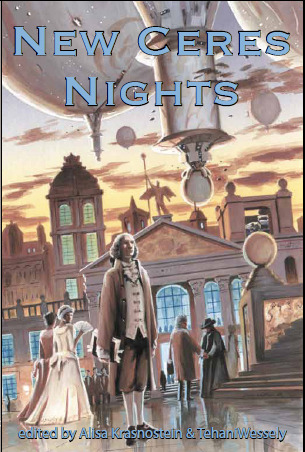
New Ceres Nights edited by Alisa Kranostein and Tehani Wessely – review

This review sort of forms part of my contribution to the Australian Women Writers 2013 Reading Challenge. All my proper 2013 AWWC reviews can be found here.

I don’t think I can officially claim this as an Australian Women Writer’s challenge book, as only 6 out of the 13 stories are penned by Australian women. However, it show the work of many of Australian speculative fiction’s current batch of award winning female authors (think Kaaron Warren, Angela Slatter, Thoraiya Dyer, Sue Isle, Tansy Rayner Roberts, Sylvia Kelso), so I’ll probably promote this through AWW channels.

And in my mind I’ll count it as a 1/2 contribution to my target.


New Ceres Nights

New Ceres Nights was published in 2009 by Twelfth Planet Press. The premise of the anthology is that the stories are all set in the shared world of New Ceres, a planet in the outer colonies that has embraced (and ruthlessly enforces) an 18th century way of life. Apart from a single spaceport connecting it to the rest of the human race, the technological level of the whole planet has been wound back.

I found the background to this anthology interesting. The introduction by New Ceres Board members Tansy Rayner Roberts and Dirk Flinthart, tells of a world built by an online community of mainly Australian speculative fiction writers, artists and fans. This was a bit before my time (as regular readers of this blog know I have only been involving myself in the Australian spec fic scene for the last year or two), but it seems like a fascinating experiment in using the internet to build community.

As far as I can tell, the New Ceres project is gone (all links seem to lead to dead-ends and defunct sites), so reading this anthology feels like a glimpse into a now departed phase of Australian speculative fiction history. A few other artefacts survive (such as the book Angel Rising by Dirk Flinthart) as well as some cryptic references to an eZine, but that is about it.

It’s too bad – I liked what I’ve read so far. It would have been fascinating to have a look at all the shared “source material” as well just to see how the world was constructed. It reminds me of a recent Kickstarter the Massive Fiction Project, which is aiming to build a shared world for fiction writing. I’m interested in these kinds of endeavours and constructs, would have been great to see an Australian attempt.

If any reader of this article was involved in the New Ceres shared world experience, I’d love to hear from you in the comments section below.

Anyway enough tangental musings, why don’t we return to the actual book. From the back blurb: “New Ceres Nights presents thirteen exciting stories of rebellion, debauchery, decadence, subterfuge and murder, set against the backdrop of powdered wigs, coffee houses, balls and duels”.

The mixture of 18th century limitations and illicit high technology made a surprisingly powerful combination, reminiscent of some of the better steampunk stories I’ve read. All the stories were quite good, I can’t really call out one I didn’t like. As is my habit, I’ll only comment on those stories where I have something to say – which is no reflection on the other stories of course!

  • The first story of the collection, Debutante by Dirk Flinthart, gives a very effective introduction to the world of New Ceres. Set somewhat before the rest of the anthology, it is an origins story of a sort. Flinthart’s dialogue is particularly sharp, and the ending to this tale gives you a real sense of the tone of the collection.
  • The contrast between the first story and the second (The Widow’s Seven Candles by Thoraiya Dyer) is quite stark, as the reader is thrown from a relatively hi-tech scenario to a very low tech one. Dyer’s writing is very engaging, and she creates a very sympathetic lead character in the candlemaker Etienne.
  • Murder in Laochan by Aliette de Bodard was notable in its use of a non-European 18th century backdrop. I also quite liked the conceit behind the main character, and found the story a delight to read.
  • Speaking of interesting conceits, Tontine Mary by Kaaron Warren (whose work I have been enjoying a lot of late) draws on an actual feature of 18th century life, the tontine. A tontine is essentially a lottery, where a group of people put in money and the last surviving member gets it all. Warren captures the life of the title character marvellously, so much so that her parting “gift” to her great grand-daughter is all the more affecting because of the sympathy you have developed over the course of the story.
  • Tansy Rayner Roberts‘ background as a comedic writer comes through in the somewhat arch Prosperine When It Sizzles. Sharp dialogue and great pacing made this a very enjoyable read.
  • Blessed Are The Dead The Rain Falls Upon by Martin Livings introduces an element of the detective noir genre into the world of New Ceres. I enjoyed the change of pace, and the point of view character was well realised.
  • The anthology is rounded out by The Piece of Ice in Miss Windermere’s Heart by Angela Slatter. This story, extremely well written, had one of my favourite characters of the book, the gentlewoman thief Ms Violet Windermere. While filled with humorous asides, Slatter does engender a connection with the character that left me wanting more.

The anthology also included the excellent:

All in all I found that I really enjoyed this anthology and have no hesitation in recommending it.

UPDATE 5/5/2013

The good people at Twelfth Planet Press tell me that the cryptically referenced eZines from the New Ceres shared world days are being published as eBooks. The first was released just a couple of days ago. Good timing on my part, no?

I also reviewed this book on Goodreads. View all my reviews.


Creative Commons License
This work by Mark Webb is licensed under a Creative Commons Attribution-ShareAlike 3.0 Australia License.


Conflux 9 – the workshops

As I’ve mentioned in a few other posts, I’m off to my first Conflux convention (Conflux 9) next weekend. I’m looking forward to it, this convention I’ve signed up for some workshops to complement my tendency to generally lurk around.

It was very difficult to pick out workshops, there were often a couple on at the same time that I would have loved to go to. I chose sessions on the basis of how much they might help with my own writing (it needs all the help it can get!). My final selection included:

  • Writing to Sell with Patty Jansen (Thursday 25th). The workshop looks at long term strategies for selling your work. Given I haven’t actually made a paying sale as yet, it might be seen as a trifle presumptuous to consider long term sales strategies, but I like to think ahead. I’m also very keen to hear about the relative merits of different publishing paths. My travel plans mean I’ll be cutting it a little fine in making it to the start of the session (fellow participants forgive me if I’m late!).
  • Polishing Your Turds with Ian McHugh (Friday 26th). I need to get a lot better at editing my own work. When I send pieces out to beta-readers, I’m usually a bit embarrassed by the sheer number of observations I get back that I should have caught myself. McHugh is a very well regarded short story writer and I do most of my work in the short story domain at the moment. Besides, if this doesn’t win the prize for the “best-workshop-name-in-a-speculative-fiction-convention-in-Canberra-during-2013”, then the whole integrity of my fictitious awards system must be immediately brought into question.
  • Vivid, Vivid Characters with Karen Miller (Saturday 27th). I recently read and enjoyed Miller’s The Accidental Sorcerer, and her name (as well as her guest of honour status) was what first caught my eye re: this workshop. Characters and character development seem to be what I have most trouble with in my own writing. In my flash fiction it hasn’t been so much of a problem (not much space for character development), but as I’ve been attempting longer works, one of the most frequent comments from my readers has been “while the plot idea is interesting, the characters are not engaging enough”. I’m hoping to pick up a few tips here!
  • The Keys to the Kingdom continued: what professional writers do to stay on top of the game with Jack Dann (Saturday 27th). I couldn’t pass up a chance to hear from/work with Dann, and the theme of the workshop (paraphrased “offers a hands on, step-by-step writing strategy and chance to broaden working knowledge of speculative fiction”) sounds very engaging. This workshop follows straight on from the Karen Miller workshop above, meaning roughly 5 hours of workshops on Saturday morning. I may be a little brain fried by the end.

It was disappointing to see that several workshops had to be cancelled because of lack of numbers (including a couple of very interesting looking ones I couldn’t get to because of scheduling clashes). On a selfish level (the level where I work best), I’m glad the workshops I selected all remained on the schedule. I guess the cancellations might be a reflection of the fact that Conflux is as much a fan convention as a writing one, so not everyone attending would be interested in the workshop topics.

Of course there is a lot more to Conflux than just workshops. Excellent panels abound and the tantalising opportunity to catch up with people from the full spectrum of the field cannot be resisted. Ditmar awards will be handed out, interesting guests of honour will be probed by insightful interviewers and I suspect that good times will be had by all.

I’ll be in and out a bit through the conference, I used to live in Canberra so my time is being split between conference attendance and catching up with friends. But if you’re attending as well, make sure you come up and introduce yourself if we haven’t met already (or even if we have!). Perhaps we can have a chat over a refreshing beverage or two.

Bitter Seeds review – now at a podcast near you

Those that follow Antipodean SF will know that the editor, Nuke, also does a podcast where all the stories are read out, usually by the authors themselves.

The recent review I did of Bitter Seeds by Ian Tregillis was narrated by yours truly on the latest edition of the podcast. It kicks in at around the 44m mark.

Enjoy!

The Accidental Sorcerer by K. E. Mills – review

This review forms part of my contribution to the Australian Women Writers 2013 Reading Challenge. All my 2013 AWWC reviews can be found here.


 The Accidental Sorcerer

The Accidental Sorcerer by K. E. Mills has been on my to be read list for quite some time. The main reason I hadn’t read it was fairly simple – Amazon kept telling me it wasn’t available on Kindle. Later books in the Rogue Agent series were, just the first one wasn’t. I liked the blurb. I was intrigued by the concept. But the website kept telling me that the book couldn’t be purchased in my country.

What a bloody cheek I thought to myself. It’s an Australian author and everything. I hate the labyrinthian world of international publication rights.

Turns out I must have been doing something stupid. I eventually stumbled across the eBook version through some combination of searches and following links from other books. Now it shows up very easily when I search for the obscure phrase “The Accidental Sorcerer K E Mills”. <insert deity of choice here> knows what I was doing before.

Anyway, book firmly (but electronically) in hand, I started reading. The Accidental Sorcerer is based in an alternate Earth, somewhere in the equivalent of the late 19th/early 20th century. The main difference is that magic is very real and is being combined in interesting ways with the products of the industrial revolution. Our hero, Gerald Dunwoody, is a lowly ranked wizard on the edge of giving up his dreams of greatness. He has taken a public service job as a magical safety inspector and is sent on a surprise inspection of a magic staff manufacturing facility when things go horribly wrong. He manages to avert complete catastrophe (something that shouldn’t have been possible for such a low powered wizard) but still manages to get blamed for it all. Rather than stay in the England-equivalent country (Ottoland), he takes a job in the colonies in a small, unremarkable country (New Ottoland) as court wizard, hoping that the heat will eventually die down. Bad things ensue.

I enjoyed the alternate world aspect, especially examining how society might progress if magic was real and pervasive. The “mother country/colony” dynamic was explored, which has particular resonance for an Australian audience constantly battling with our own cultural cringe. It had that very British sensibility that I always enjoy.

I also liked the magic system. While not described in huge detail, there was that iceberg sense that Mills had worked this through under the surface so that the parts poking up into the air had a certain consistency.

I was a bit hit and miss with some of the dialogue. There was some excellent banter between characters, but also some that was trying a bit too hard to be witty. The voice of one of the minor characters (Reg the bird) didn’t quite strike the right chord for me, I could see what the character was meant to be, but it didn’t quite gel. Her mysterious history as a powerful political player in the past didn’t really match some of her more superficial comments as the plot progressed. However, other minor characters (such as Monk) were very nicely characterised.

The first half of the novel is quite light hearted. The second half moves into much darker and morally ambiguous territory. I really liked the contrast, and also how this transition established the scene for further novels. I think if the tone had stayed on the light end, I would have struggled to see how this could have been anything more than a one off novel. There was enough complexity by the end to justify an ongoing series.

I don’t want to spoil anything, but also can I say that the set up for future novels (the premise for Gerald’s future career) was great, and I especially appreciated how elements had been introduced through the book that came together nicely to support that direction. That’s a bit cryptic, but you should know what I mean once you’ve read the book.

I will be reading the other books in this series (at some undisclosed point in the future when I am more up to date with my current reading). In the mean time I commend The Accidental Sorcerer for your reading pleasure.

I also reviewed this book on Goodreads. View all my reviews.


Creative Commons License
This work by Mark Webb is licensed under a Creative Commons Attribution-ShareAlike 3.0 Australia License.


What is the sound of one hand writing? Or is it typing?

Another interesting thread from a writing mailing list has inspired another slightly tangental post on my behalf. The question – do you write long hand or directly into the computer?

My early career was in the computer industry and I’ve always had computers in my working life, so when I started to write I got myself set up with a laptop and the Scrivener writing software package and did all of my drafting electronically.

However, recently I realised that I have a lot of trouble turning off my inner editor when I write on the computer. I’m always going back and fiddling with sentences. This was fine when I was writing primarily flash fiction, but it has become a bit problematic when tackling longer pieces. I can’t get me no momentum!

So recently I’ve been writing longhand on lunch breaks, while waiting for my daughter to finish her dance lesson, in the stolen moments when the kids go off to a birthday party – basically anywhere I can grab a few minutes spare. I seem to be much better at saying “oh that’s roughly correct, I’ll fix it when I type this up” when I’m writing by hand. As a result, I’m getting more first draft material down without my internal critic slowing me up. Also, the typing up process is an excellent way of giving my work a first level line edit. And for those that have read my writing, you’ll know the more editing the better!

Of course I also have a growing volume of almost indecipherable hand written semi-prose that I haven’t quite got around to typing up yet. And, every minute that goes by reduces the chance I’ll ever be able to re-interpret my own scribbling, meaning some story ideas and fragments may be lost forever. But that’s the price I pay for the impetus gaining by a moving object.

I’ve also been giving some thought to writing materials. Recently I’ve begun using a series of “whiteline” books (where the page is a very very light grey and the lines are white). Much easier on the eye. Sadly I haven’t yet found a pen I really like, so I drift from shop to shop constantly searching, never finding true pen love.

What about you? Is your preference for long hand or is it electronic-word-capture-or-bust? Have you found pen love? A particularly well formed notebook, whose pages soak up your speculative fictive ink like a sponge in a rock pool? The perfect keyboard for your iPad, allowing your fingers to fly faster than light while you sit at the local cafe? Do sponges in rock pools actually soak up anything? Tell me all about it.

Submitting stories – going against wise counsel

I recently attended the NSW Speculative Fiction Festival where many fine speakers imparted much accumulated wisdom. A good time was had by all. There was one session focusing on the art and craft of short story writing, chaired by Cat Sparks and including Angela SlatterLisa Hannett and Dirk Strasser. All very accomplished writers, editors and publishers with a plethora of awards between them. One of the main pieces of advice they gave was submit to pro markets first. Why publish your story for free when someone might pay you for it? Why take 2c a word when someone might pay 10c a word? Why miss an opportunity for your work to get out to the wider audiences that the pro markets command?

Why?

It’s good advice. It is logical. Across the room I could feel the pluck of my fellow neophyte writers stiffen as we all resolved to send our short stories to Asimov’s as soon as we got home. I suspect the online submission systems of many a professional magazine were swamped with stories from down under. I did it myself, adding some prestigious names to my steadily growing pile of rejections (always boilerplate rejections, never those good personally written ones that everyone talks about :-). And as we’re always told, you’re probably being rejected because your work isn’t quite right for that particular editor at that particular time. Sure, some work is rejected because it isn’t good enough, but not yours. Never yours. Right?

I like my stories. When I leave them for long enough that I can barely remember writing them and re-read them as if I’m reading a strangers work, I enjoy the experience. They aren’t literary, but then I’m not a literary guy. I think they are OK. And considering I’ve only been writing for a short time, that’s good. I’m proud of the work I do.

But OK work that I’m proud of does not necessarily a pro market publication make. And some markets take months to get back to you. By my rough calculations, if you submitted to every pro market that gives you credit towards say joining Science Fiction Writers of America, your story could be tied up for years. And stories sitting in slush piles do not help me learn how to be better.

I’m beginning to think that what I need to be focusing on is mid-tier semi-pro markets where an editor might take some interest in my work, and perhaps provide suggestions on how it could be improved. At this stage, that would be much more valuable to me than large amounts of money. The flash fiction pieces I’ve published on Antipodean SF have been fantastic experiences, working with the editor there (Ion Newcombe) to make them better. Perhaps I need the equivalent for longer works.

I’m undecided. The lure of a pro market sale is strong. But I know I’ve got a lot to learn about the craft of writing, and wasting time sending solid but not dazzlingly brilliant stories to markets that are never going to publish them might not be such a great idea.

So, my friends – what do you think? For the writers out there, what is your approach to short story submissions? Is it all-pro-all-the-time? Free to a good home? Somewhere in between?


So… many… award… lists…

Work has kept me a bit busy over the last couple of weeks, so I haven’t had a lot of time to add to the blog. In that time, three different sets of Australian award nominations have come out (in chronological order of release):

  1. 2012 Aurealis Awards
  2. 2012 Australian Shadow Awards
  3. 2013 Ditmars

I’m not going to repeat all the nominations here (follow the links above), but I did want to draw out a few highlights.

Firstly, Kirstyn McDermott and Jason Nahrung have cemented their place as the Australian speculative fiction writing power couple by securing nominations in all three awards. In previous posts I’ve expressed my love for their recent work, PerfectionsBlood and Dust and SalvageAll three appear in this year’s awards, which is especially impressive considering Perfections and Blood and Dust were only released just before Christmas 2012.

Secondly, Sean Wright (or Sean the Bookonaut) is up for several Ditmars in the fan writing/publications sections. Sean is an excellent contributor to the Australian speculative fiction scene, made even more impressive by the fact that he does it all from a secret (1) rural South Australian location with dodgy internet connections. If you’ve not come across his work before, it is well worth your time to track down his site and podcast.

Thirdly, Antipodean SF (who published a few of my flash fiction pieces last year) are up for best fan publication in the Ditmars. It is amazing how many established writers I talk to who say “Oh, yes – Antipodean SF is where I got my first story published”. Ion Newcombe is an excellent editor and generous contributor to the Australian speculative fiction scene. If you’ve never seen Antipodean SF, I’d encourage you to check the site out. (2)

Finally, I really enjoyed Kaaron Warren‘s collection Through Splintered Walls last year. I can see the stories from this book (and the collection itself) sprinkled all through these awards list. A fantastic book, well worth checking out.

I’ve decided that after I’ve finished my current reading, I’m going to make a concerted effort to plug some of the gaps in my Australian reading using these award lists as a guide. What about you? Have you read much of the work doing the rounds in this year’s awards season? Anything stand out?


(1) The secret thing may not be entirely factually accurate

(2) I help out preparing the e-Book edition of Antipodean SF each month, so I’m not entirely without bias here.

Day jobs and writing

“Day jobs and writing” was the subject of a recent thread on a writing mailing list I subscribe to. It was interesting reading about how a lot of people struggle with a job that lets them pay the bills, but takes them away from their first love, writing. There was a lot of dreaming of the day when they could chuck the day job and write full time. I threw my $0.02 in, and I thought I might repeat some of the sentiments here.

I love my day job. I work in the public sector (government work), and get a great sense of satisfaction out of serving the society I live in. My day job does not involve large amounts of writing, and what writing there is takes the form of briefing notes etc. The job is very demanding in terms of hours which makes it hard to fit in writing. I also have chosen to live within walking distance of my work, so no commute time to do writing (but with an hour and a half of walking each day, plenty of time to think about writing!). I have a young family – so difficult to fit writing around family activities. I do wish I had more time for writing.

However, I do not aspire to be a full time writer.

I’ve only been writing for a couple of years (late starter – I blame the mid life crisis) and I always felt obscurely guilty about the fact I didn’t want to be a full time writer. I went to a few writing courses and conventions, and there was a lot of attitude that translated to “if you are serious about your craft, your goal has to be to be a full time writer. Therefore if you don’t aspire to full time writer status, you can’t be a ‘real’ writer”. It was a bit depressing – I began to feel that I didn’t “belong” in the writing community.

Then I went to a panel session at the excellent GenreCon in Sydney Australia late last year and there was a writer that I admire saying that he loves writing, that he is absolutely serious about his craft, that he always wants to improve, that he loves being published but that he didn’t want to be a full time writer.

He loved his day job. He loved not feeling commercial pressure to make money from writing and the creative freedom that offered him. That he hoped to “break even” on his writing, but that his writing business plan had at its goal being a part time writer.

I felt good after that session, let me tell you.

So, I love my day job. I love writing. Long may they both live!

What about you?

NSW Speculative Fiction Festival 2013

Yesterday (Saturday 16th March) I attended the second NSW Speculative Fiction Festival at the NSW Writers’ Centre.

I started off badly, having somehow got it into my head that the day started at 10:30am. I turned up to a full car park, but couldn’t find any people. Imagine the fierceness of my blushing when I realised everyone was in the first session, which had been going for over 1/2 hour. I decided to wait for the second session to save the stinging embarrassment of entering 5 minutes before the end. It also let me pre-order my lunch. Win-win in my books.

My second problem came when the lovely people manning the front desk realised my badge had been taken! An impostor was roaming the rooms of the festival, having stolen my identity and slipped comfortably into the persona of a complete neophyte writer with no paid publications to his name.

Wait, why would someone do that?

I was assured that they had seen my badge that very morning, but now it was nowhere to be found. A hastily constructed replacement around my neck, I set forth to conquer the festival.

But I kept an eye on every name badge I passed, I can tell you.

So, the second session of the day and the first I attended was titled Publishing Into the Future, chaired by Russell Farr (of Ticonderoga Press) with panel members Zoe Walton (Random House Australia), Joel Naoum (Momentum) and Dionne Lister. The general answer to the question “what is the future of publishing” seemed to be “buggered if we know”, but there was some interesting exploration of the mix of publishing options and a general expectation that the book would survive, in some form or another. Phew. I enjoyed the panel, although some answers were a little verbose, I think they could have covered a lot more ground in the time available. That being said, there was some interesting reflections on the changes in marketing that have accompanied the rise of the eBook. If I ever publish a novel in eBook only format, I’ll have a lot to think about.

I also got to hear Joel Naoum’s theory relating interactive books to masturbation. I can’t do it justice. Next time you’re talking with him, bring it up.

The second panel, The Allure of Epic Fantasy, was chaired by Ian Irvine and included Melina Marchetta, Pamela Freeman and Garth Nix (a last minute substitute for Duncan Lay). The panel ended up focusing more on the authors writing style (plotter vs pantster) and their general approach to writing. Garth Nix was a very polished presenter (obviously gets a lot of practice). Actually, all four panelists were excellent in this session, and while it was only tangentially covering epic fantasy, I found this the “inspiring” session of the day.

All inspired, I then enjoyed lunch with the inimitable Lynda Young. Lyn has been a great support to me in my writing and I always enjoy the chance to catch up. Lyn had a story published in a US based anthology (Make Believe) last year, and I really enjoyed hearing about her experiments in marketing in that environment (I had to admit that while I bought the anthology and read her story just after it was released, I hadn’t quite got to the other stories in the anthology and so hadn’t done a review on this website. Bad writing friend. Must fix that as quickly as possible).

Towards the end of lunch we were joined by Patrick Keuning, a relatively new writer who has recently got his first paid publication with a story in the new In-Fabula Divino anthology. Patrick was (justifiably) as pleased as punch, and I saw him actively promoting the book throughout the day. He has documented his experience of the day on his website, go and have a look to hear more! Rick has also provided excellent feedback on my work in the past, I’m looking forward to seeing more of his writing in the future.

After lunch I attended Oh the Horror! The Future of Weird Fiction. I was excited about this panel, it contained three of my favourite authors – Deborah Biancotti, Kirstyn McDermott and Jason Nahrung. Actually, now I’m worried that the fourth member of the panel, Robert Hood, might feel left out. Robert, I know you probably read the blog. I have to admit I haven’t had the pleasure of reading your work as yet. But I’m sure you would be one of my favourite writers if I had, based on nothing other than the company you keep.

In any case, I digress (did someone mention “too verbose” earlier in this blog? Friends, let’s not quibble). The panel tried to define “horror”, in contrast with “weird”. I really liked Nahrung’s characterisation – horror tries to take something known and make it unknown and leave the reader unsettled, while weird tries to take something known and make it unknown, but leave the reader with a sense of wonder (he said it better than that, but that is why he is a name brand author and I’m writing this blog post).

A very interesting dissection of the broad horror genre ensued. Horror is one part of the speculative fiction spectrum that I’ve struggled to grapple with and I always like the chance to hear skilled practitioners debate the craft.

This session was also notable because in it, while listening to a brief aside about the atheist nature of zombies, I was suddenly struck with a new angle to a story I’ve been struggling with for ages. I really liked the angle as well. To be honest, I would have considered the whole day a success just for that. Good times.

In any case, I ended that session suitably creeped out.

The next session I attended was Short and Not So Sweet: writing and publishing short fiction, chaired by Cat Sparks and including Angela Slatter, Lisa Hannett and Dirk Strasser. An interesting discussion on the short story market was had, with some great thoughts on whether we were on the edge of another short story boom as people seek out bite-sized content to consume on the go. There was universal agreement that one should start submitting to the pro-markets immediately, but I did keep in mind that this was a group of multi-award winning short story writers. With their skills, I’d probably focus on the pro markets as well. I’m pretty sure there are no awards in my near future, but still the advice to aim high is good advice.

As an aside, Cat Sparks (who is the fiction editor at Cosmos, which is a pro market) noted the lack of Australian submissions to her publication. I thought to myself “Well, she’ll get a few more on the back of saying that“, but I notice that Cosmos is currently closed for submissions. As is Aurealis, where fellow panel member Dirk Strasser holds court. I suspect there are a lot of disappointed newbie writers out there today!

I popped out to stretch my legs before the last session, and bumped into Jason Nahrung. We started chatting about his new book (Blood and Dust, which I reviewed here and is available from Amazon or at the publisher Xoum’s website). It was an interesting conversation, covering everything from the challenges of marketing in the eBook world, through to my experience of reading Blood and Dust and even Jason’s process in working on his next novel (which I’m very excited about!). In fact, it was so interesting that I completely forgot to attend the last session of the day. Oops. I’m sure others have covered in admirably in other blogs.

Some further brief but interesting chats with Ben Chandler on his role in evaluating grant applications in South Australia and Richard Harland on his upcoming steampunk release (Song of the Slums). Before I knew it, the book launch of Prickle Moon by Juliet Marillier from Ticonderoga Press had started. So over a glass of red, I had the pleasure of listening to some excellent readings and general discussion of the book.

Sadly, it being after 6:00pm and my wife having been stuck with enjoyed the company of the children all day, I had to head off. Just like last time, I found the festival to be a great re-charger of my enthusiasm batteries. I look forward to many more.

Next stop – Conflux.

Oh, and I never did find my doppelgänger.