Patronising Musketeer Space

Wait, maybe that isn’t the greatest title for this post. Oh well, I’ve typed it now. Editing three words seems like a lot of work.

I have become a patron of the arts! Well, of an art. “How did this happen?” I hear you ask. No, no – too late. You’re committed to hearing an answer now.

As Jeeves (*) was driving me down to the Opera House to smoke cigars and laugh at student protestors with my wealthy mates, it occurred to me that with my fabulous riches came the obligation to be seen to support the arts. Of course I don’t want to actually hang around with creative types. Bohemian grungy plebs with their dreadlocks and their communism. No, I was delicately balanced on the horns of a dilemma. How did I maintain my social status by being able to talk about the “worthy” causes I supported, without actually touching any of the people involved in them?

Jeeves pointed out that the Internet was handy for the whole not-actually-physically-interacting thing. After I had him roundly whipped for speaking to his betters without permission, I had a sudden thought. It occurred to me that the Internet is handy for the whole not-actually-physically-interacting thing. So I sought out causes whose worth I could talk about and donate to without actually meeting any of the artists.

And that was how I came across Musketeer Space, an initiative by Tasmanian writer Tansy Rayner Roberts.

To quote from the artist herself:

Musketeer Space is a (mostly) gender-swapped retelling of The Three Musketeers by Alexandre Dumas, one of my favourite all time books, as a space opera. The gender-swapping aspect is part of the experiment – I wanted to challenge some of my own preconceptions about gender and narrative, and taking a classic novel apart like this is a fun way to do it. Plus I love space opera, the kind with heightened drama and romance, and I think there’s nothing wrong with mashing up spaceships with swashbuckle.

Roberts will be publishing one chapter a week of this interesting sounding book, and the first chapter is now online on her website. She also gives an update on the experience of using Patreon to gather ongoing funding.

I highly enjoyed the first chapter and decided to dip my toe in the waters of patronising by pledging a monthly amount. There are some interesting advantages in pledging at higher levels, and while I don’t need a fictional spaceship named after me (my membership of a nameless secret society dedicated to maintaining clandestine contact with our alien overlords means I have an actual spaceship named after me), the idea of getting extra information from the author in the form of a regular newsletter certainly appealed.

So if you, like me, yearn to add “Patron of the Arts” to your resume, why not head over to the Musketeer Space Patreon page and get involved.


(*) of course it would be a wild coincidence if someone called Jeeves actually decided to become a butler/driver. So wild that I won’t insult your intelligence by pretending that is actually what happened. I made him change his name when he came into my service of course.

Short Story Sale – Electric Spec

I was very excited earlier in the week to hear that the fine people at Electric Spec wanted to publish one of my short stories, titled Showdown.

Who are Electric Spec? In their own words:

Electric Spec is a not-for-profit speculative fiction magazine published four times per year. Our primary goal is getting great speculative fiction into the hands (or screens) of readers. Since 2005, we’ve been publishing short stories from authors all over the world. We’ve worked with all kinds of authors, from published professionals to new writers. We also believe in the value of the editorial process, and we edit every story we publish. 

Electric Spec have recently published a blog article announcing some of the first line up for their next edition (including me!), which can be found here.

I’m really excited to work with Lesley and the rest of the Electric Spec editorial team on bringing Showdown to life. The edition is due to be published on May 31, and I hope you read and enjoy my story.

The Rogue by Trudi Canavan – review

This review forms part of my contribution to the Australian Women Writers 2014 Reading Challenge. All my 2014 AWWC reviews can be found here.


The Rogue

The Rogue is the second book in the Traitor Spy trilogy. I reviewed the first book, The Ambassador’s Mission, here.

The story follows straight on from The Ambassador’s Mission. I found myself gravitating towards the “home” plot, involving Cery the thief, Sonea the Black Magician and some internal shenanigans in the Guild, rather than the one that followed a trail of international intrigue. Still, The Rogue expanded even more on the politics wider world and introduced some tantalising glimpses into other societies, which I found quite interesting. Canavan has created a complex and intriguing world and I’m sure there was a depth of world building that went on to create such a coherent narrative.

As with the first novel, the pacing was a little slow for me. At the end of the day I just wasn’t worried for the main characters. I suspect this was one of the reasons that I warmed to a sub-plot involving a new character tricked into learning black magic. As the character was new, I wasn’t as certain that they’d survive, and that added an extra dollop of tension, which I quite liked.

Great to see a normalisation of homosexual relationships, with the same attention given to the gay character’s love life as the straight ones.  Truth be told, there were points where I found all the relationships a little vexing (“you’re the Ambassador man, no good can come from sleeping with a senior official in another government!”) but then I’m becoming a cranky old man (who apparently dislikes other people’s happiness) faster than I’d like.

All in all a very solid middle novel to an enjoyable trilogy.

I also reviewed this book on Goodreads. View all my reviews.


Creative Commons License

This work by Mark Webb is licensed under a Creative Commons Attribution-ShareAlike 3.0 Australia License.

April 2014 – mini reviews

So, what have I read in April?

Words of Radiance (Stormlight Archives) by Brandon Sanderson is a great popcorn read. I liked the first book in the Stormlight Archives, and I kept coming back to this second book. I don’t often get so caught up in a book. These are huge fat fantasy novels, but ones that I really like.

Inspired  by the previous read, I also grabbed one of Sanderson’s first books, Elantris. It was interesting to go back and read such an early work, Sanderson has certainly honed his craft over the years. However, some of the elements that makes his later work so addictive were there – the multiple points of view, a logically developed magic system. Mostly I found it interesting to think about the journey Sanderson has made as an author though.

Traitor Queen by Trudi Canavan will be another one of my Australian Women Writers Reading Challenge reviews, so nothing about that here.

I forgot to mention in the previous post that I also read the latest Discworld novel Raising Steam by Terry Pratchett. I love the Discworld series, and the latest is as good as ever. If you have been reading the books, you’ll read this one whether I recommend it or not. If you haven’t, there are better jumping on points earlier in the series. But definitely a good book for the fans.

I started on King Rat by China Mieville but haven’t finished yet. More on that in May.

And that’s the month that was April 2014!

Galactic Chat up for a Ditmar

So, the preliminary Ditmars ballot is out and a podcast that I contributed to last year (Galactic Chat) has been nominated. It’s the first time a speculative fiction project I’ve been involved in has been nominated for an award, so its very exciting.

The 2014 Ditmar preliminary ballot can be found here, but to save that extra click, Galactic Chat can be found in the Best Fan Publication in Any Medium category, which I’ve reproduced below.

Best Fan Publication in Any Medium

  • Dark Matter Zine, Nalini Haynes
  • SF Commentary, Bruce Gillespie
  • The Writer and the Critic, Kirstyn McDermott and Ian Mond
  • Galactic Chat Podcast, Sean Wright, Alex Pierce, Helen Stubbs, David McDonald, and Mark Webb
  • The Coode Street Podcast, Gary K. Wolfe and Jonathan Strahan
  • Galactic Suburbia, Alisa Krasnostein, Alex Pierce, and Tansy Rayner Roberts

Those that follow speculative fiction awards closely may have already noticed that three of our competitors are up for the Hugo award for Best Fancast (The Writer and the Critic, Galactic Suburbia and The Coode Street Podcast).

Now just because we’re up against three Hugo nominated podcasts doesn’t mean we have any less chance…
(…checks facts…)
Ah, apparently it does mean we have less of a chance. Still, I like to think of us as a plucky band of misfits taking on the might of the establishment, and unless fiction has lied to me my entire life that means we’re almost certain to win…
(…checks facts again…)
OK, apparently fiction has lied to me my entire life. Ummm, it’s an honour to be nominated?
(…checks facts a third time…)
Yes, it’s an honour to be nominated.
Phew.
I should also mention that several of the Galactic Chat “cast” have further nominations.
  • David McDonald has been nominated for the William J Atheling Award for Criticism or Review;
  • Alex Pierce was nominated twice for the Atheling, is part of the Galactic Suburbia team AND was nominated for Best Fan Writer; and
  • Sean Wright, leader of aforementioned plucky band of misfits, has also been nominated for the Best Fan Writer award.

All nominations are very well deserved – its been a pleasure working with all the members of the Galactic Chat crew and it’s great to see them being recognised for their diverse talents.

The Ditmars are presented each year at the Australian National Science Fiction Convention, which this year is Melbourne’s Continuum, held in early June.

Wefting the Warp online

I recently blogged that my story, Wefting the Warp, had been purchased and published by Robot and Rayguna UK based speculative fiction magazine. The first publication was done through eBook form, available through Amazon and other fine eBook retailers.

For those not wanting to purchase the eBook version, good news. Robot and Raygun progressively publish each month’s stories on their website. My story is now freely available. Go and check it out. While you’re there, why not read the other fine fiction Robot and Raygun have been publishing?

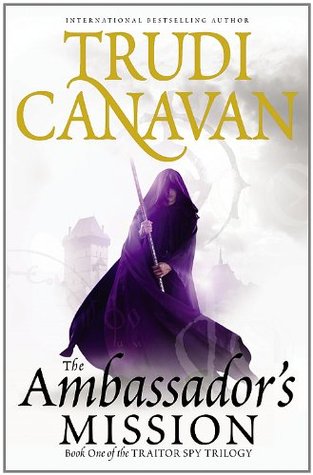
The Ambassador’s Mission by Trudi Canavan – review

This review forms part of my contribution to the Australian Women Writers 2014 Reading Challenge. All my 2014 AWWC reviews can be found here.


The Ambassador's Mission

My first review for the 2014 Australian Women Writers’ challenge. I’m very slow of the mark this year.

Years ago I read Canavan’s first trilogy set in this world – The Black Magician trilogy. I enjoyed it at the time, but hadn’t really followed up on any of Canavan’s other work. When looking for books for the 2014 Australian Women Writers challenge, the thought of continuing some adventures in the same world appealed.

Having been years since reading the first trilogy, it took me a while to re-orient myself in The Ambassador’s Mission. There was a bit of assumed knowledge in the first few chapters – assumed knowledge that I couldn’t quite bring to bear. It made the first part of the novel hard going – I couldn’t remember the rules of the world, exactly what black magic was (for instance), who the characters from the last trilogy were and their relationships with each other.

Once I got past that “entrance exam”, I remembered why I’d liked the first trilogy. Canavan has created an interesting world and this new book expanded that world significantly. The focus on different countries and cultures was very interesting.

Canavan makes interesting comments on same sex relationships and gendered power imbalances through some of her choices for her characters. The points are well made without being overwhelming and I think added to a more sophisticated feel for the book.

Having said all that, the plot is a little slow for my tastes and it didn’t feel like the characters were in enough “peril” (for want of a better word). I never strongly felt that there was a possibility that they would fail (or die), and without that I found it difficult to get as strongly engaged with the characters as I would have liked.

A great book and well worth the read, especially if you like a more sophisticated take on a secondary world fantasy.

I also reviewed this book on Goodreads. View all my reviews.


Creative Commons License
This work by Mark Webb is licensed under a Creative Commons Attribution-ShareAlike 3.0 Australia License.


Catch up December 2013 – March 2014 – mini reviews

This post contains the first of my “reviews in brief” for books I’ve read. Normally this will be a monthly post, but this month I’ve got to catch up a few months in a row.

Over the summer break (that’s December for any northern hemisphere readers), my wife and I  took the kids to Bali and Western Australia, to visit my brother-in-law and his family for Christmas. Here is a chance to put a dent in the dreaded Kindle to-be-read pile I thought to myself as we set off.

I didn’t. I read Wild Card books instead.

Wild Cards is a anthology series that first came out in the 1980s. It deals with a world where an alien virus kills 90% of the people infected by it (Black Queens), hideously deforms 9% (Jokers), and transforms the lucky 1% into super powered Aces. I loved it at the time, it was a super hero style universe without the somewhat cheesy standard DC/Marvel super heroes that I’d become jaded with in my teen years. Hey, it was the pre-hipster era. Nobody told me you could watch things like Batman and The Incredible Hulk ironically.

I remembered the series recently when I was preparing to attend a George RR Martin interview at the Opera House and came across the first Wild Card book in one of my many boxes of books while looking for my copy of the first volume of Game of Thrones for Martin to sign.

On a whim I looked it up on Amazon to see if you could get copies for the Kindle. I’d never been able to find all the books in the series as a kid (pre-internet and all that).

And there it was, an eBook copy of the original with extra bonus stories. I downloaded it and was instantly transported into 1980’s me heaven. Fortunately it had not been visited by the suck fairy. I devoured it, and then spent the rest of the holidays reading all the books that had been re-released on Kindle. Including the original trilogy:

  • Wild Cards
  • Aces High
  • Jokers Wild

These first three books were very much anthologies, with significantly varied stories. I was amazed at how well a lot of the story telling had held up. These was some material that might be considered slightly problematic in terms of how women are portrayed, but it didn’t seem to grate too much (at least not with me). Super powers in the 80s.

There is a significant gap – it seems like quite a few of the books are yet to make it to eBook form (although from looking at future releases it seems like they are making their way through them over the next year or two). I skipped forward to  a much more recent stand alone book and subsequent trilogy, that was made up of straight novels with an ongoing plot.

  • Death Draws Five
  • Busted Flush
  • Inside Straight
  • Suicide Kings

I didn’t enjoy these four as much as the original books, but it was interesting jumping forward to the 2000s to see how the world had evolved. In particular, watching a world evolve to deal with people whose card might “turn” any time from puberty onwards, especially when they are under stress. I probably preferred the first stand alone novel (Death Draws Five) to the trilogy.

On top of these, I also read two stand alone books. Dueces Down  tells the story of people who get powers, but they are so weak that they don’t really count as Aces. The second book – Fort Freak – was a mosaic novel focusing on the police station that operates out of Jokertown – the Joker slum in New York City. Both were interesting reads, and while not as powerful as the original set of books, they still were very entertaining. So, 9 books later I’d finished my holiday and made virtually no dent in my existing reading pile.

The next four of the older books will be released over the next three months, and I suspect you’ll see them show up in a future monthly review.

I also read the first two books in the Traitor Spy trilogy by Trudi Canavan, however I’m planning a full review of those books for the 2014 Australian Women Writers Challenge so I won’t say any more about them.

The Long War by Terry Pratchett and Stephen Baxter is the sequel to The Long Earth, a story about the discovery of many, many unpopulated parallel versions of Earth and mankind’s colonisation of them. It was a good story, well told but lacked the wow factor of the first book, and the stakes didn’t seem very high. It seemed to be setting up for a third book in the series – perhaps that one will be more exciting!

There – we’re up to date.


Dimension6 launches

Dimension6

I’m very excited to see a new speculative fiction magazine launch in Australia. It’s Dimension6, Keith Stevenson’s latest venture through his publishing house Coeur de Lion.

Long time readers might recall that I interviewed Keith for GalacticChat a few months back. Keith is a mainstay of the Australian speculative fiction scene and one of its true innovators. I’m excited to see what he’ll do with Dimension6.

Go and check it out – can’t argue with the price (free!).

This website is also an affiliate for Dimension6 – you can download each issue’s copy from this page.

Getting to “The End” – novel first draft finished

Well, last night I wrote the words “The End” in the notebook I’ve been writing my novel Unaligned in. Those that have been following along with the blog know that I’ve been trying a new approach to getting regular writing done this year, and because of it I’ve managed to get to the end of the first draft of the novel I started back in 2011 (and pretty much abandoned throughout 2013) over the last three months.

Of course I still have to convert the last 20,000 words from freak-localised-household-fire-could-ruin-me notebooks to backed-up-in-about-4-different-places-should-survive-the-apocalypse electronic form. And then do a structural edit, because I’m pretty sure the end doesn’t connect up properly with the beginning given the 2 years between writing the two parts. And even a cursory read over my early work makes me blush, as, now that I think of it, does a cursory reading over my later work. So lots of copy editing. And the dialogue could use some work. And there are a lot of dodgy/lazy metaphors. And I’m worried the ending doesn’t have the right level of crescendo.

But apart from that, it’s excellent.

But despite all that it feels like an achievement. At GenreCon last year, crime author John Connolly talked a lot about finishing the things you start. While I was listening to him, my normal cynical self was parsing his words as self help clap trap. But despite that initial reaction, those words stuck with me and I began to realise that not finishing the novel was subtly bugging me. My reasons for leaving it to one side had been sound – there was a lot of life going on at the time that quite rightly demanded my attention and I decided that in what little time I had available to write I wanted to practice my craft on shorter length pieces, where I could get more immediate payback/feedback. But not finishing was creating friction in my subconscious, that tiny irritation that’s always there but hard to detect until its gone.

Well now its gone.

I’m excited about the challenge of editing and making the story the best it can be. There’s a lot of work ahead – more than the effort of getting this first version down, that’s for sure. But I am left feeling that a milestone has been met, and I didn’t want to let that pass by without note.

So, let it here be noted.